
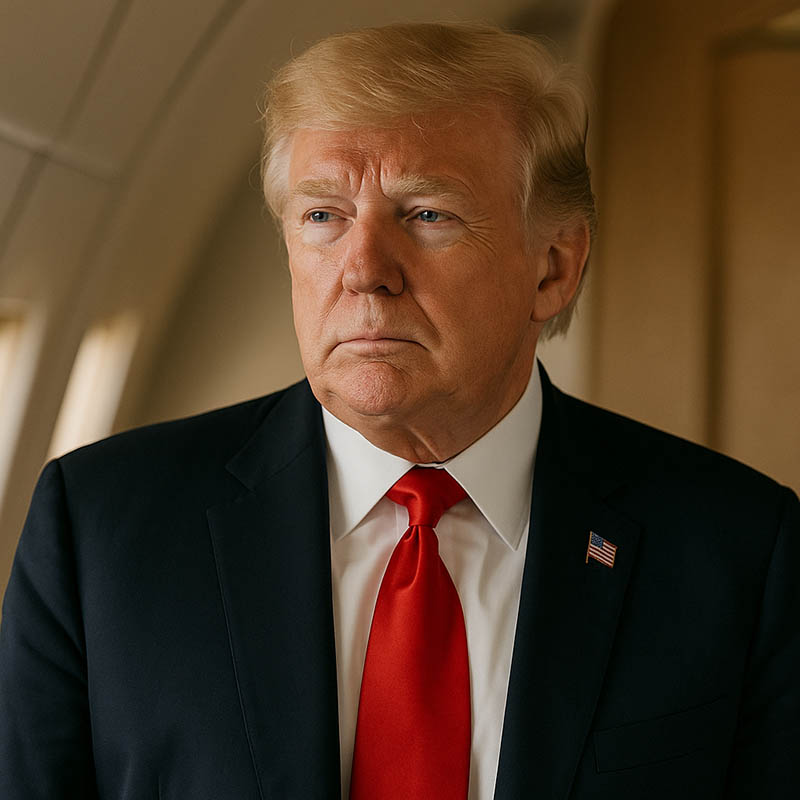


The White House has confirmed that U.S. President Donald Trump’s departure from the NATO summit in Turkey aboard the older Air Force One aircraft was a deliberate security measure utilizing “distraction and misdirection.” According to White House Communications Director Steven Cheung, the decision was implemented to address heightened security threats against the president. This tactical transportation adjustment occurred shortly after President Trump publicly stated that he remains a primary target for Iran amid escalating bilateral tensions.
While reports indicated that the U.S. Secret Service recommended the use of the older aircraft, President Trump offered an alternative explanation on social media. He stated that the newly acquired $400 million Boeing 747-8 Air Force One was dispatched to Mildenhall Air Force Base in the United Kingdom to allow U.S. military personnel to tour the vessel. Trump later rejoined the new aircraft at the British base for his transatlantic flight back to the United States, describing the logistical detour as a minor deviation from his standard return flight path.
The security precautions coincide with a significant deterioration in relations between Washington and Tehran. During a press conference at the NATO summit, President Trump declared that a temporary ceasefire agreement with Iran had concluded following a series of military exchanges. Expressing deep skepticism regarding future diplomatic engagement, Trump asserted that further negotiations with Iranian authorities would be counterproductive, citing active threats directed at his life by the Islamic Republic.
The diplomatic breakdown follows intense military action in the Middle East, initiated by U.S. precision strikes on over 80 Iranian targets after alleged Iranian attacks on commercial shipping in the Strait of Hormuz. In response, Iran’s Islamic Revolutionary Guard Corps launched missile and drone operations targeting key U.S. military installations in Bahrain and Kuwait. U.S. Central Command subsequently conducted a second wave of airstrikes against approximately 90 Iranian military assets, emphasizing its commitment to holding Tehran accountable for regional maritime disruptions.


