
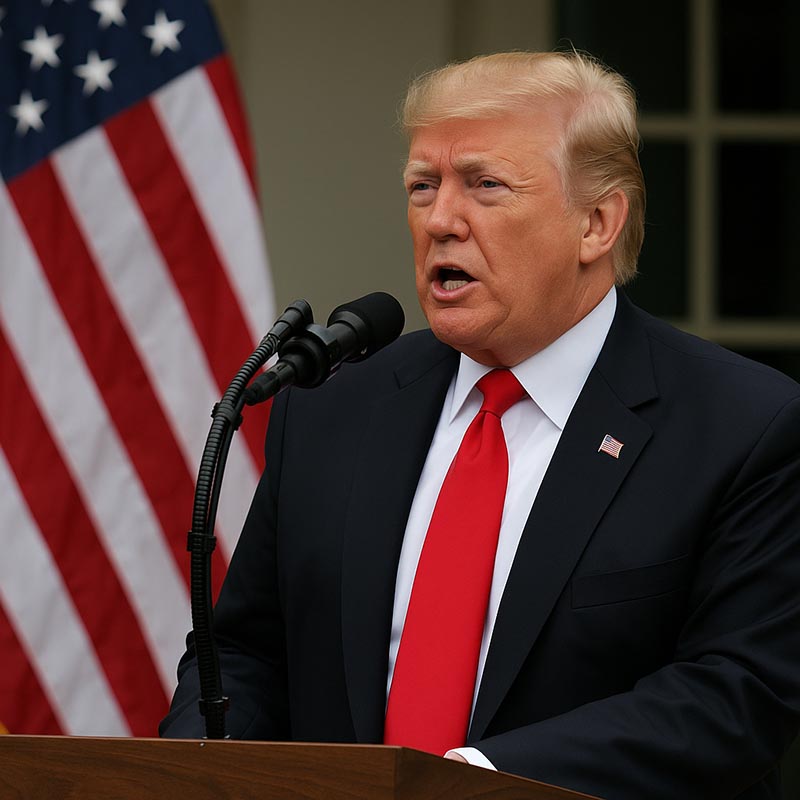


Payam Javan: United States President Donald Trump has announced the launch of an unprecedented economic campaign against Iran, characterizing the measures as the most severe financial sanctions ever imposed on any nation. The announcement, made on Wednesday, marks a significant escalation in Washington’s strategy to isolate Tehran, following what the U.S. administration described as Iran’s failure to negotiate a diplomatic agreement.
Under the newly declared policy, the U.S. administration intends to penalize foreign nations, financial institutions, and private enterprises that provide any form of economic support to Iran. President Trump warned that entities facilitating trade, aviation, or financial transactions with Tehran would face severe economic consequences from the United States, targeting activities such as oil smuggling, cash transfers, and the use of front companies.
Describing the initiative as an “Economic D-Day,” the U.S. president called on international allies to align with Washington to isolate the Iranian government. This economic escalation follows months of intensive U.S. military operations in the Middle East, which the administration asserts were designed to neutralize Iran’s nuclear weapons capabilities and counter its regional influence.
In his public statements, President Trump claimed that previous military and economic pressures have already severely diminished Iran’s defense and financial infrastructure. He asserted that the country’s naval and air forces have been heavily degraded, its military manufacturing facilities compromised, and its national currency rendered virtually worthless, leaving the nation in a highly vulnerable state.
The transition to intensive economic warfare comes amid a prolonged breakdown in diplomatic channels between Washington and Tehran. Efforts to negotiate a diplomatic resolution have repeatedly stalled, with both sides trading accusations of treaty violations and failing to find common ground to de-escalate the ongoing conflict.
U.S. Treasury Secretary Scott Bessent confirmed that the department has been instructed to apply “maximum pressure” to enforce the new restrictions. According to Bessent, the strategy will pair global economic isolation with an ongoing naval blockade in the Strait of Hormuz, a critical maritime transit route, to restrict the movement of goods into and out of Iranian ports.
The latest escalation follows a sharp rise in regional tensions, including a recent decision by the United Arab Emirates to halt trade relations with Iran. The UAE’s move was prompted by an incident in which Iranian forces reportedly launched two missiles targeting Emirati territory, further complicating the geopolitical dynamics of the Persian Gulf region.


