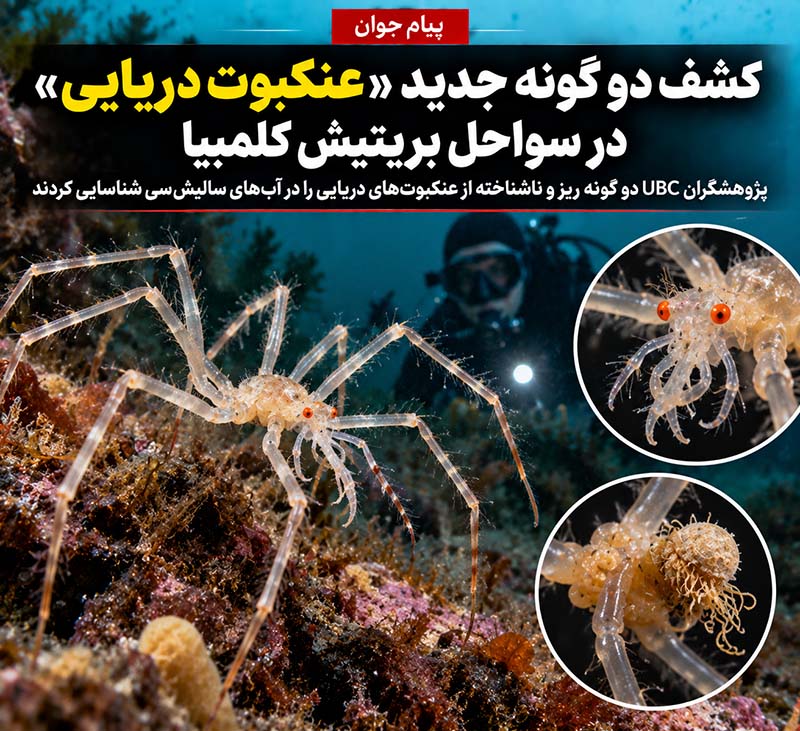


Researchers at the University of British Columbia have discovered two previously unknown species of sea spiders in the Salish Sea, combining two creatures that commonly trigger fears of spiders and deep-sea life. The tiny species, named Callipallene pilosuspedes and Tanystylum kiixin, were identified by a research team led by master’s student Cormac Toler-Scott and documented in a scientific paper published this summer.
The two species measure roughly one centimetre across their leg span and were collected during dives in waters around mainland Vancouver and Vancouver Island. Sea spiders are related to terrestrial spiders, scorpions and horseshoe crabs because they are arthropods, although sea spiders and horseshoe crabs are not technically arachnids. Unlike many other animals, sea spiders breathe through their skin, while males are responsible for carrying and caring for the developing eggs.
One of the newly identified species, Callipallene pilosuspedes, has red eyes and a translucent white body. It features a short proboscis equipped with claws for grabbing food, along with a distinctive triangular, three-lipped mouth surrounded by sensory tendrils. Males have specialized limbs near the back of the head that help transport eggs and assist with cleaning. The eggs are attached to the male using a secretion produced by his legs.
The second species, Tanystylum kiixin, was named after an ancient Indigenous village on Vancouver Island. Like the first species, it has specialized limbs near the base of its head that are involved in carrying eggs. Researchers also observed tiny parasites associated with the species, with unusual bodies resembling small turtle shells and thin, spaghetti-like structures extending from their bases.
The discoveries bring the number of documented sea spider species in the Salish Sea and along the west coast of Vancouver Island to 20, but researchers believe many more remain unidentified. Toler-Scott said he became interested in the animals partly because of concerns about how marine invertebrates in the region are affected by climate change and human activity. He noted that limited knowledge of local species and their lifestyles makes it difficult to fully understand those impacts, suggesting that further exploration could reveal even greater biodiversity beneath the region’s waters.