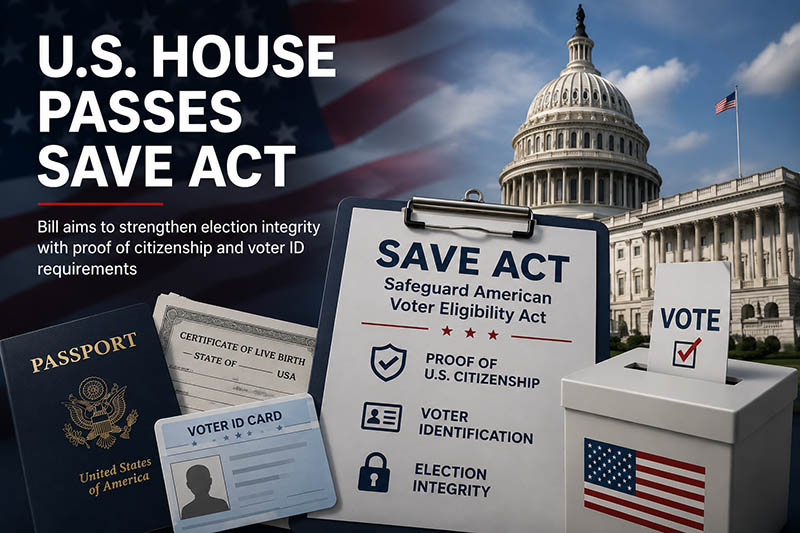


The U.S. House of Representatives has approved the Safeguard American Voter Eligibility (SAVE) Act, advancing a Republican-backed proposal that would significantly change voter registration requirements for federal elections. While supporters describe the measure as a major step toward strengthening election integrity, critics argue it could create new barriers for eligible voters.
The bill passed the House by a 215–211 vote, requiring individuals registering to vote in federal elections to provide documentary proof of U.S. citizenship. Acceptable documents could include a U.S. passport, a birth certificate, or other government-issued records verifying citizenship.
Supporters of the SAVE Act argue that the legislation is designed to ensure that only U.S. citizens are registered to vote in federal elections. They contend that requiring proof of citizenship would strengthen election security, improve public confidence in election outcomes, and reduce the risk of voter fraud involving non-citizens.
Republican lawmakers have emphasized that although federal law already prohibits non-citizens from voting, the SAVE Act would establish a uniform verification process to help enforce existing election laws.
Opponents, however, argue that documented cases of non-citizen voting are extremely rare and that the proposed requirements could make voter registration more difficult for some eligible Americans. Voting rights advocates warn that individuals without immediate access to citizenship documents—or those whose legal names have changed due to marriage or other circumstances—could face additional obstacles when registering to vote.
The debate surrounding the SAVE Act reflects a broader political divide in the United States over how to balance election security with voter accessibility. Republicans generally frame the legislation as a necessary safeguard against potential election fraud, while Democrats and voting rights organizations argue that it risks disenfranchising legitimate voters without addressing a widespread problem.
Although the bill has cleared the House of Representatives, it has not yet become law. The legislation must still be considered by the U.S. Senate before it can be sent to the President for final approval.
If enacted, the SAVE Act would represent one of the most significant changes to federal voter registration requirements in recent years and is expected to remain a central issue in the national debate over election administration.