
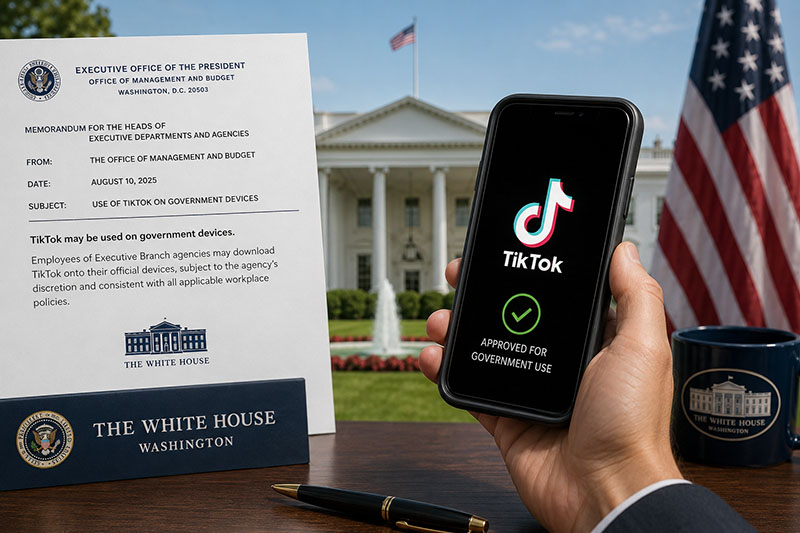


Payam Javan: The United States executive branch has formally eased restrictions on the use of the social media application TikTok on government-issued devices. In a memorandum issued on August 10, the Office of Management and Budget (OMB) informed heads of executive departments and agencies that employees are now permitted to use the application under specific guidelines. This directive aligns with a previous legal assessment by the Department of Justice (DOJ) issued in July, marking a significant shift in federal policy regarding the platform.
The policy change represents a notable departure from the comprehensive federal ban enacted in 2022. At the time, Congress passed the No TikTok on Government Devices Act amid heightened bipartisan concerns over national security, data privacy, and the influence of TikTok’s Chinese parent company, ByteDance. Federal authorities had expressed apprehension that user data could be accessed by foreign entities, leading to strict limitations across various levels of government.
According to federal officials, the decision to permit the application rests on structural changes in how TikTok operates within the United States. The domestic version of the platform is now managed by the TikTok U.S. Data Security (USDS) Joint Venture, which is predominantly owned by American investors. Major financial and technology firms, including Oracle, MGX, and Silver Lake, collectively hold a 45 percent stake in the joint venture, which has overhauled its algorithm and cybersecurity protocols.
In its July memorandum, the Department of Justice concluded that the restructured U.S. version of TikTok no longer falls under the statutory definition of prohibited applications. The DOJ highlighted that the USDS joint venture employs independent, third-party cybersecurity experts to monitor privacy standards and detect potential vulnerabilities. The department noted that these extensive safeguards render the platform as secure as, if not more secure than, other mainstream social networking services.
Despite the overarching executive clearance, individual federal agencies retain the authority to implement their own restrictions. The DOJ memo emphasized that executive departments can independently decide whether to prohibit the application on their respective devices based on localized security assessments. Furthermore, TikTok remains strictly banned on congressional devices within the House and Senate, as well as on state-owned devices in several states, including Texas and Virginia.
The evolving policy landscape follows years of regulatory pressure and legislative action aimed at foreign-controlled software. In 2024, Congress passed the Protecting Americans from Foreign Adversary Controlled Applications Act, which restricts the distribution of applications deemed to be controlled by foreign adversaries. However, implementation of associated bans has faced delays, with President Donald Trump postponing the enforcement of such measures since taking office.
As regulatory hurdles ease, several high-profile federal entities have actively established a presence on the platform to engage with the public. Following the DOJ’s legal clarification, the Departments of the Treasury, Transportation, and Health and Human Services launched official TikTok accounts, joining the White House, which established its own account last year. This growing institutional adoption highlights a pragmatic shift toward utilizing the platform for public communication despite ongoing geopolitical debates.


