


From War to Survival: The Islamic Republic on the Path Toward Accommodation with the West.
The Process of Eliminating and Replacing Opponents — and the Opposition’s Delusion (1)
By: Shardad Khabir
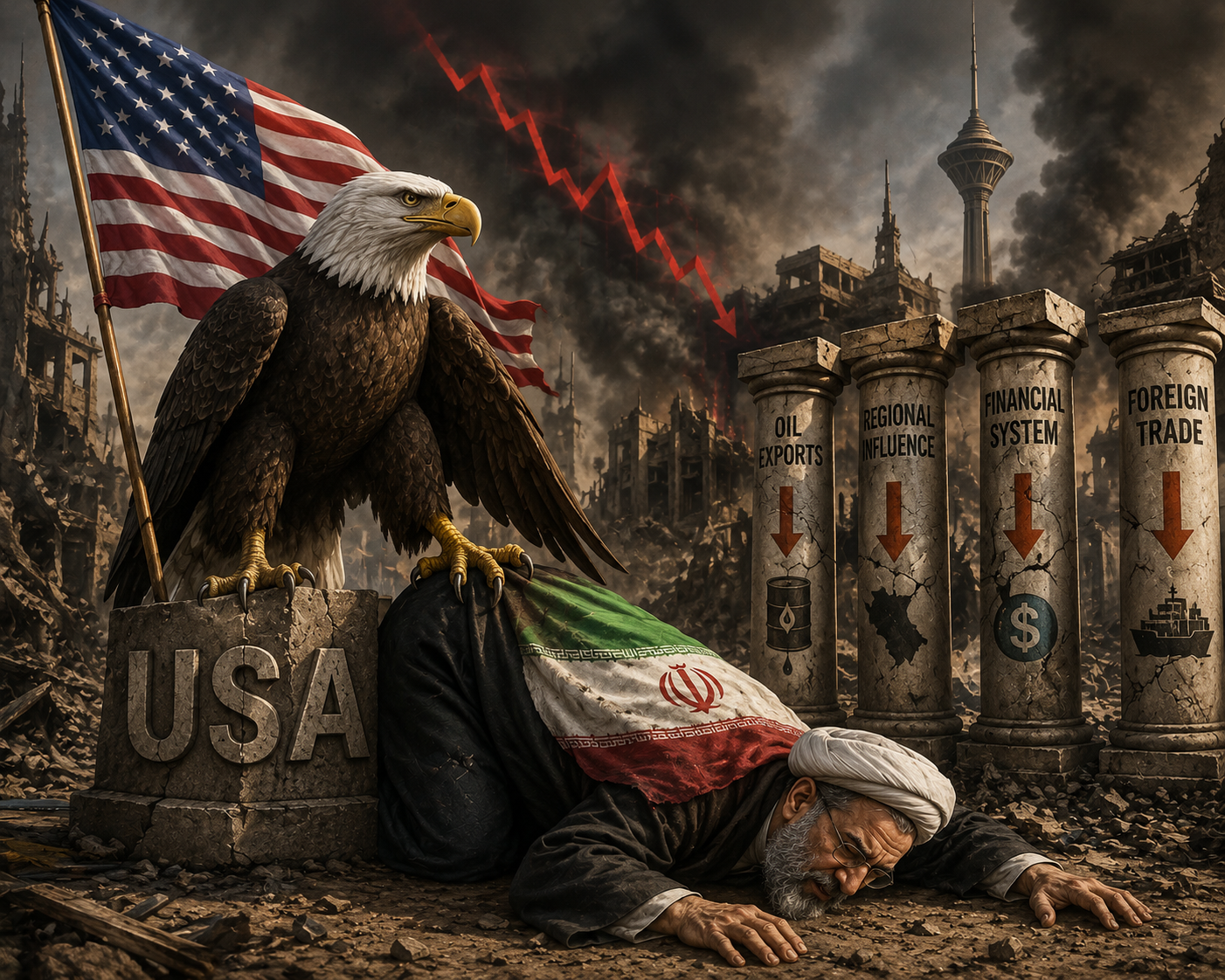
The recent war was not merely a military confrontation; it delivered a heavy blow to the economic, financial, and regional pillars of the Islamic Republic. It revealed that the regime’s ability to continue its past policies is not unlimited, and that as military and economic pressure intensifies, its range of choices narrows. Although the government may still speak publicly of resistance and steadfastness, the economic reality tells a different story: a system that depends on foreign currency, oil exports, international trade, and relative market stability cannot ignore sustained external pressure.
The recent memorandum of understanding must be viewed within this context. This agreement is not a sign of victory for the Islamic Republic, but rather an indication of its need for breathing space. The regime found itself in a position where it had no choice but to accept any opening that could reduce economic pressure and prevent further erosion. In clearer terms, the Islamic Republic did not accept this agreement from a position of strength; it accepted it as an opportunity to preserve its survival. In such circumstances, signing the agreement is not an endpoint but the beginning of a gradual, step by step process. A government that needs relief from external pressure to sell oil, obtain foreign currency, calm the markets, control inflation, and prevent public discontent is compelled to respond more positively to the demands of the other side. These responses may initially be limited and cautious, but the logic of economic pressure inevitably pushes the regime toward greater cooperation.
The nuclear program lies at the center of this pressure. If the Islamic Republic wishes to benefit economically from the agreement, it must show cooperation on nuclear transparency, inspections, technical limitations, and reducing the concerns of the United States and the international community. Official propaganda may frame such cooperation as “crisis management” or a “tactical decision,” but in practice it means accepting parts of the demands the regime previously resisted. Iran’s economy today cannot withstand a prolonged war combined with widespread commercial blockage. Oil and petrochemical exports are vital for bringing in foreign currency. Imports of industrial components, livestock feed, medicine, medical equipment, and raw materials are essential for sustaining production. When these channels are threatened, pressure falls not only on the government but on the daily lives of ordinary people. Inflation, declining purchasing power, production stagnation, and rising costs of essential goods are direct consequences of such conditions.
Furthermore, the war has limited the Islamic Republic’s ability to financially support its proxy forces. Supporting regional groups requires money, equipment, secure transfer routes, and logistical capacity. When the state struggles to cover domestic expenses and maintain market stability, financing regional projects becomes increasingly difficult. Thus, the war not only exhausted the domestic economy but also strained the regime’s aggressive foreign policy.
Had the war continued, the Islamic Republic might not have collapsed immediately, but its economic lifeline would have gradually suffocated. The government could have survived for a time through reserves, land routes, limited trade, and pressure on the population, but each additional month of war would have imposed heavier costs. Eventually, the state would have been forced to choose between internal security, essential goods supply, proxy support, and costly military programs. For this reason, the recent agreement with the United States should be seen as an emergency pause in a trajectory of erosion. By signing it, the regime effectively acknowledged that continuing on its previous path would have imposed even greater costs. The agreement gives the government a chance to breathe — but that breathing space is not free. Every step of pressure reduction will be accompanied by a new demand: more transparency, more cooperation, more limitations, and more accountability.
In other words, the Islamic Republic has now entered a phase in which, to preserve its survival, it must respond positively to external pressure step by step. This path may be slow, tense, and wrapped in domestic propaganda, but its overall direction is clear: a government that needs economic relief cannot reject all the demands of the other side and still expect to escape pressure.
Ultimately, the recent war demonstrated that the Islamic Republic’s power is more fragile than official propaganda suggests. The MOU is not a return to past strength but an entry into a phase of survival management. If the regime wishes to move beyond this phase, it will have to show greater flexibility toward the demands of the United States and the international community. This flexibility may be masked by the rhetoric of resistance, but in reality, it stems from economic pressure, declining foreign currency revenues, and the regime’s need to stay alive.
The rapid pace of events over the past year revealed that the determination and organizational capacity of the regime’s ideologically driven, newly empowered factions — and the breadth of their strategic ambitions — exceeded even the expectations of the most pessimistic analysts, including myself. Personally, I believe that continuous practical and theoretical assistance from China and Russia, combined with periodic Western leniency, played a major role. From the day after the 1979 coup, the political goals and methods of this regime — alien to modern governance and rooted in a machinery of repression — were so clearly structured that they could hardly have emerged without foreign design and intervention.
Meanwhile, deep religious beliefs and long standing feudal cultural traditions provided the ideological fuel that kept this reactionary system burning for half a century, powering its repression, terror, militarism, and violence. Over time, as the regime’s true nature became exposed, its support base steadily eroded. Gradually, the Islamic Republic attempted to rebuild a loyal minority through professionalized corruption, patronage, and rent seeking, mobilizing them during critical moments. Whatever the case, we now face a political system and historical reality in which the “law abiding” bureaucratic and executive wing of the regime is actively organizing and consolidating its supporters across all administrative, military, and political institutions. To preserve itself up to the brink of death, it is prepared to confront the so called “fundamentalists,” “ideological hardliners,” and “concerned loyalists,” and in doing so, it increasingly relies on the West as its natural ally — albeit within a fluid and highly volatile framework of international relations, especially with the West.
For domestic showmanship after Khamenei’s funeral, the Islamic Republic launched attacks on U.S. bases and oil tankers in the Strait of Hormuz. But this move was based on miscalculation: the regime assumed the United States would refrain from responding in order to preserve the path toward an agreement. Contrary to this assumption, the U.S. responded with military strikes, oil sanctions, and regional pressure — forcing the regime toward signing an even tougher deal. If Tehran believes it can extract concessions by holding Hormuz hostage, Washington may shift from “containing the regime” to “crippling the regime.”
…to be continued


