


🎧 نسخه صوتی این مطلب
“Swine and the Citadel of Humans”
I am one who would not cast
This precious pearl of the Persian tongue
At the feet of swine.
By: Shardad Khabir
Chan-Chun sat on the carpet and said:
“I am a wild mountain dweller and for many years have practiced the Way of Tao, the path of the original and supreme nature. I walk in the wilderness or stand there absorbed in contemplation and spiritual insight. But here, near Your Majesty, amid the bustle of armies, horses, and chariots, my spirit finds no peace. Would it be permitted for me to travel as I please, sometimes ahead of your army and sometimes behind it?”
The Khan replied: “Let it be as you wish. Now explain something to me. What is thunder? They say the gods become angry when people abandon ancient customs and sacrifice animals of the wrong color instead of black ones. Is this true?”
Chan-Chun answered:
“The anger of Heaven is not caused by deficiencies or excesses in sacrifices, Yet none of these things are signs of disrespect toward Heaven. Rather, Heaven is offended by the countless wicked deeds committed by human beings. I have read in ancient books that among three thousand forms of wrongdoing, the worst is disrespect toward one’s parents. They feast and drink to excess while leaving their aged fathers and mothers hungry. It is this disrespect of sons and daughters toward their parents that causes righteous Heaven to become angry and punish mankind with thunder and lightning. Great Khan, devote yourself to reforming your people and guiding them along the path of reason.”
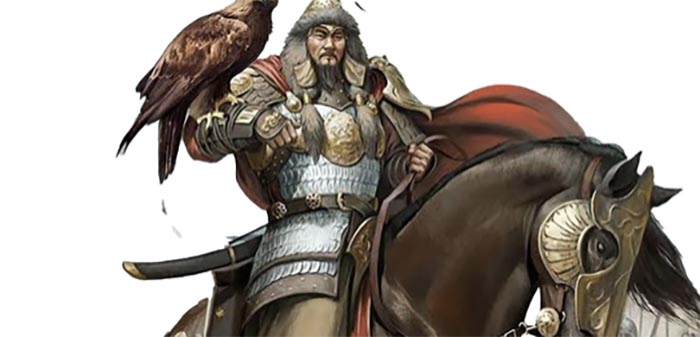
Genghis Khan said: “This wise man speaks well.”
He then ordered that translators proclaim a special law concerning the necessity of honoring one’s parents. (This law was later incorporated into the Great Yassa of Genghis Khan.)
The Khan asked: “Holy sage, for a long time I have wished to know whether you possess an elixir that can restore youth to the old and strength to the weak. Can you make my life continue without end, flowing forever like the waters of a great river? Do you possess an elixir of immortality?”
Genghis Khan continued: “If you do not have such a potion, perhaps you know how to make it. If you can provide me with an elixir of immortality, I shall reward you greatly. I will make you a Noyan (a noble commander) and appoint you governor of a vast province. I will fill your saddlebags with gold coins and give you a hundred beautiful maidens from many lands.”
The Khan continued tempting him:“I shall build you a palace upon your mountain, so magnificent that it will surpass even the palace of the Emperor of China. I do not even need youth. Let me remain old and white-haired as I am. I only wish to rule for countless years over the vast Mongol realm that I have built with my own hands.”
The old man in a quiet voice he replied:
“What use have I for gold, who love mountains, silence, and contemplation? If I cannot govern myself completely, how could I govern a province? Give all those beautiful maidens in marriage to worthy young men. I have no need of a palace; I can immerse myself in contemplation upon the rocks of the mountains.
No secret remains hidden from me. I can tell you the certain truth: there are many remedies that strengthen the body, heal illnesses, and preserve life, but there is no elixir of immortality, nor has there ever been one.”
Genghis spoke:
“The Mongols have a saying: ‘A truthful man does not die of illness; it is his enemies who end his life before its time.’
Therefore, people strive to build mountains of lies. But you, wise old man, who have traveled ten thousand li to meet me, are the only person who was not afraid to tell the truth and say that no elixir of immortality exists. You are honest and pure-hearted. If you desire anything, ask for it, and I promise to grant your wish.”
Chan-Chun said: “I have only one request. I crossed snowy roads, mountains, and valleys solely to bring it before you. Listen carefully: End your endless wars. Become a benefactor to all peoples and nations. Establish peace and harmony everywhere.”
Genghis Khan frowned deeply. He shouted:
“War is necessary if peace is to prevail everywhere! It is not without reason that our elders of the steppes say that only when an irreconcilable enemy is destroyed can true peace exist. Yet I have not crushed my ancient enemy, Burkhan, king of the Tanguts. Half the world is still beyond my power. How could I tolerate such a situation?
Though you are a wise man, your request is not reasonable. Do not trouble us again with such wishes!”
Khan rose slightly and, trembling with anger, shouted:
“You are dismissed!”
Chan-Chun lived thereafter in the Kok Saray (“Blue Palace”), the former palace of the Kharazm Shahs, located outside the city amid gardens, where he spent his time composing poetry.
Genghis Khan spent that winter near Samarkand. He disliked the confined atmosphere of cities and remained in the Mongol camp.
Later, by Genghis Khan’s order, Turkan Khatun—the aged queen of Kharazm and mother of Sultan Mohammad—along with all the former royal wives and other captive nobles, were required to stand in rows along the route of the Mongol march and lament the destruction of the Kharazmian kingdom as the entire Mongol army passed before them. (Year 1223 A.D.)


