
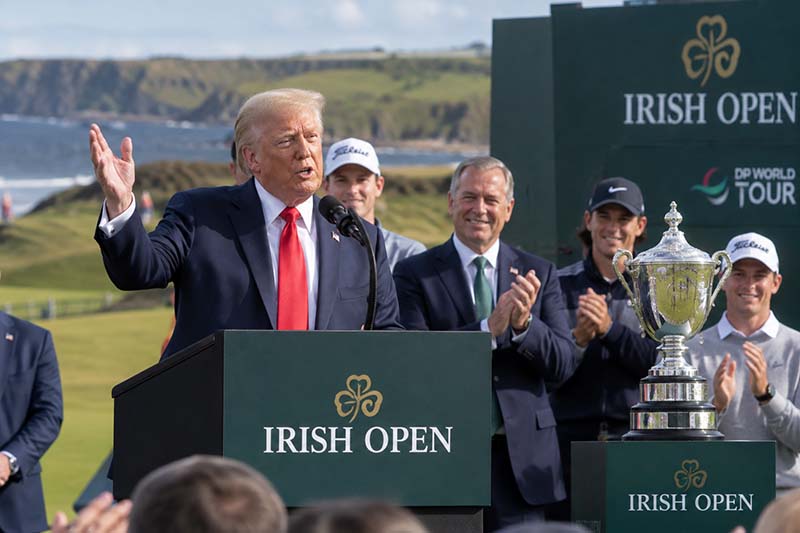


Payam Javan: President Donald Trump has announced his decision to lift tariffs on Irish whiskey, a move disclosed during his appearance at the conclusion of a golf tournament in Ireland. The decision follows persistent inquiries regarding the 10 percent tariff currently applied to imports originating from the European Union. During the trophy ceremony for the Irish Open, the President noted that he had been frequently urged to address the matter by various stakeholders, including professional golfers participating in the event. In response to these requests, he formally declared that the United States would discontinue the trade levy on Irish spirits.
This policy shift follows the earlier removal of tariffs on U.K.-produced whiskey, including products from Scotland and Northern Ireland, which was enacted in April. The announcement was met with positive reception from the crowd in attendance, signaling a significant adjustment in trade relations between the United States and the European Union. Prior to the President’s declaration, the Irish Whiskey Association had actively campaigned for the removal of the tariff, citing the discrepancy created by the exemption previously granted to Northern Irish products. The association highlighted that Irish whiskey exports to the American market hold an annual value of approximately $525 million.
Industry representatives argued that eliminating the tariff would alleviate market uncertainty, benefit domestic distributors of premium spirits, and bolster the American barrel-making sector. The reliance of the Irish industry on American oak casks, particularly those previously utilized for bourbon production, underscores the interconnected nature of the two markets. The trade issue was further complicated by the fact that Irish whiskey is a protected product encompassing the entire island, yet it was subjected to varying tariff structures based on the specific origin of production.
By treating the island’s output more uniformly, the administration aims to rectify previous inconsistencies in trade policy. This decision aligns with the President’s prior actions concerning spirits from Scotland, which were exempted following diplomatic engagements with the United Kingdom earlier this year. The administration has emphasized that the move is intended to foster stronger commercial ties and support vital industries within both the United States and international partners. By facilitating smoother trade, the policy is expected to enhance the collaborative relationship between the American bourbon industry and the Irish spirits sector, which share a long history of cooperation regarding manufacturing materials.


