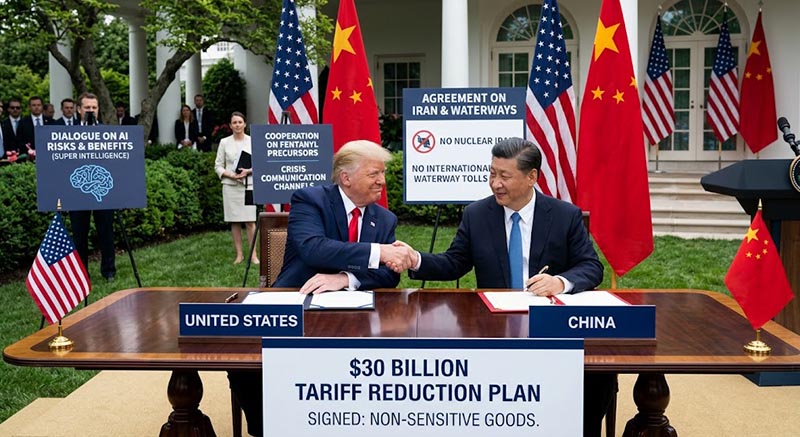


The United States and China have agreed to a reciprocal tariff-reduction arrangement covering approximately $30 billion in goods traded in each direction, following Chinese President Xi Jinping’s state visit to Washington. The agreement was confirmed by China’s Foreign Ministry after the White House released details of the understandings reached during Xi’s meetings with President Donald Trump.
The arrangement focuses on non-sensitive goods and is part of a broader set of economic agreements between the two countries. The White House has said the new trade mechanisms will address bilateral commerce, while China’s Foreign Ministry said the two sides endorsed the outcomes of recent economic and trade consultations and agreed to implement a $30 billion reciprocal tariff reduction. Specific tariff rates and implementation dates were not immediately detailed.
The two governments also agreed to strengthen trade and investment cooperation through new mechanisms, including a Board of Trade and a Board of Investment. The broader discussions included agricultural market access, critical minerals and rare-earth supplies, energy, and efforts to address barriers affecting businesses in both countries. The White House said the two sides would continue working on supply-chain concerns involving rare earths and other critical minerals.
Beyond trade, Trump and Xi reached several understandings on international and security issues. Both sides said Iran should honor its commitment not to develop nuclear weapons and agreed that no country or institution should impose tolls on international waterways. The two governments also agreed to establish a bilateral dialogue on the risks and benefits of artificial intelligence, along with a communication channel for AI-related incidents.
The agreements come as Washington and Beijing continue efforts to stabilize relations after years of trade and technology disputes. The Chinese Foreign Ministry said the two countries would pursue a “constructive China-U.S. relationship of strategic stability,” while the White House described the discussions as aimed at strengthening confidence among businesses and consumers. Further details on the tariff reductions and their implementation are expected as the two governments put the newly announced arrangements into effect.