
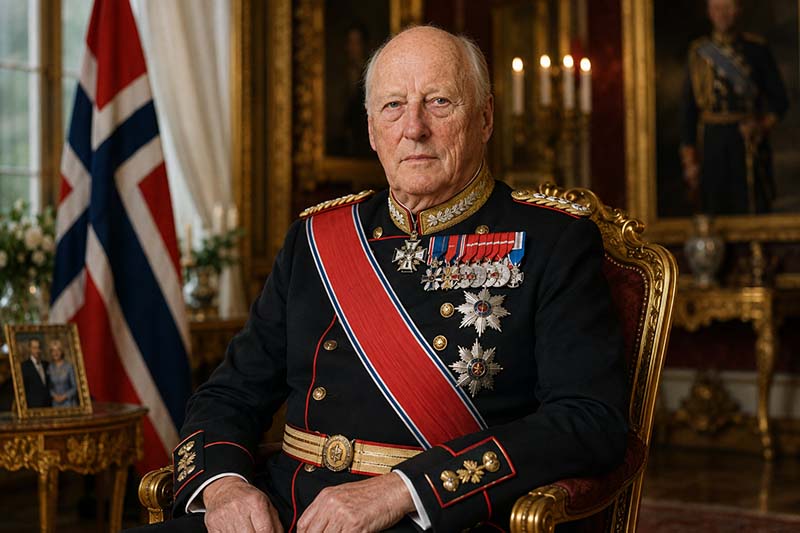


Payam Javan: King Harald V of Norway, Europe’s oldest reigning monarch, has died at the age of 89, the royal palace announced on Friday. The popular monarch passed away at the National Hospital in Oslo, concluding a reign of more than three decades that began in 1991. Following his death, his son automatically ascended the throne as King Haakon VIII. Prime Minister Jonas Gahr Støre expressed the nation’s grief, praising the late king’s unwavering faith in the Norwegian people and his decades of service.
Born in 1937 near Oslo, Harald was the first Norwegian-born prince since the 14th century, representing a relatively young modern monarchy established in 1905. His early childhood was marked by the upheaval of World War II when Nazi forces occupied Norway in 1940. To escape capture, the young prince fled into exile with his mother and sisters, spending the war years in Sweden and the United States, where they were frequent guests at the White House, before reuniting with his country’s leadership in Norway in 1945.
Upon returning to his homeland, Harald attended public schools, the Norwegian military college, and Oxford University. Mirroring his father’s athletic achievements, he developed a lifelong passion for sailing, eventually representing Norway in multiple Olympic Games and winning a World Championship gold medal in 1987. In 1968, after a nine-year struggle to gain his father’s approval to marry commoner Sonja Haraldsen instead of European royalty, the couple wed in a ceremony widely celebrated by the public, ultimately redefining the modern image of the Norwegian royal family.
Ascending the throne in January 1991 under the motto “All for Norway,” King Harald oversaw a period of significant economic prosperity driven by the country’s oil and gas sector. While the Norwegian monarchy holds a primarily symbolic role within the nation’s parliamentary democracy, Harald successfully modernized the institution to keep it relevant. He earned widespread national respect for his unifying leadership, most notably delivering a highly praised, emotional address to the nation following the 2011 extremist attacks that claimed 77 lives.
While the Norwegian royal family enjoyed decades of high popularity and relatively few scandals compared to other European houses, the later years of Harald’s reign brought increased scrutiny. Recent controversies included his daughter Princess Märtha Louise’s decision to step back from official duties, as well as scrutiny surrounding Crown Princess Mette-Marit’s past social connections. Additionally, the high-profile conviction of Mette-Marit’s eldest son from a prior relationship, Marius Borg Høiby, further tested the public standing of the royal household.
Despite facing mounting health challenges in his final years—including multiple hospitalizations and the installation of a pacemaker—King Harald consistently rejected the prospect of abdication, maintaining that his oath of service was lifelong. His steadfast commitment to his duties cemented his legacy as a stabilizing and deeply respected figure in modern Norwegian history. As King Haakon VIII assumes the crown, the nation transitions into a new era while reflecting on a legacy of modernization, resilience, and enduring public service.


