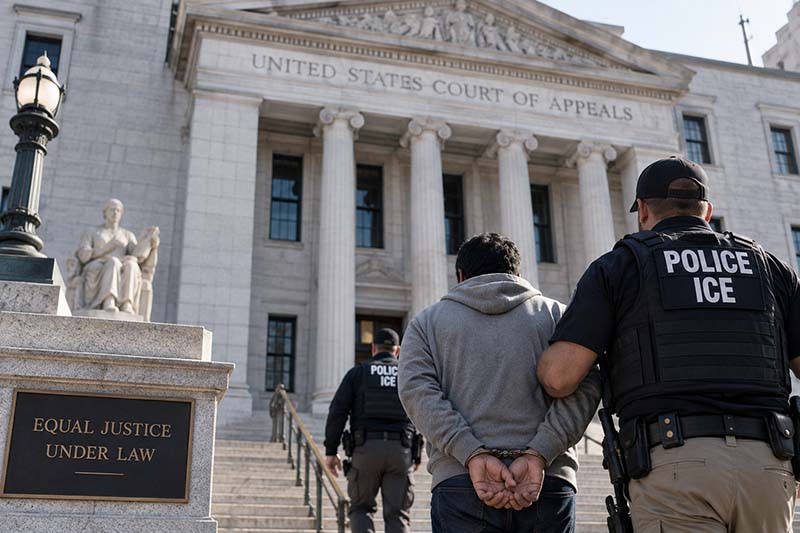


Payam Javan: A federal appeals court has issued a unanimous decision largely upholding a lower court’s ruling that halted a Trump administration policy aimed at the swift deportation of undocumented immigrants to third countries. The three-judge panel for the First Circuit Court of Appeals determined that the policy lacked sufficient safeguards, specifically questioning the reliance on “blanket assurances” from receiving nations that deportees would be protected from torture or persecution. The court emphasized that such guarantees are inadequate without concrete mechanisms to ensure the safety of foreign nationals from potential harm.
The policy in question, which was adopted by the Department of Homeland Security (DHS) in March 2025, permitted immigration officials to remove foreign nationals in as little as six hours. The legal challenge was brought by four foreign nationals who argued that the expedited process violated their rights by denying them adequate notice and a meaningful opportunity to express reasonable fears of persecution or torture in the countries to which they were being sent. The court agreed with this assessment, finding the guidance unlawful due to its conflict with existing statutory and regulatory protections.
Circuit Judge Seth Aframe, writing for the majority, noted the difficulty in accepting that receiving countries could credibly guarantee safety for all removed individuals without providing affirmative protections against rogue agents or non-state actors. The court’s opinion characterized the reasoning of the District Court for the District of Massachusetts, which originally granted a preliminary injunction against the policy, as a sensible interpretation of immigration law. This ruling effectively maintains the legal hurdle for the administration’s current enforcement strategy.
The Trump administration has consistently defended the policy as a necessary tool to manage the complexities of illegal immigration and border security. In earlier filings, government attorneys argued that the removal of individuals who are difficult to deport requires delicate diplomatic negotiations and the balancing of broader foreign policy interests. The administration had previously sought and received temporary relief from the Supreme Court, which had allowed the policy to proceed while the appeals process played out in the lower courts.
This latest development marks a significant shift in the ongoing legal battle, as the First Circuit’s decision now stands in direct opposition to the administration’s implementation of the rapid removal framework. The case, identified as D.V.D. v. Homeland Security, has garnered significant attention due to its implications for due process rights and the scope of executive authority in immigration enforcement. Legal analysts suggest that the clash between the administration’s enforcement priorities and the appellate court’s interpretation of due process will likely necessitate further review.
Given the high stakes of the litigation, it is widely expected that the case will return to the Supreme Court for a final determination. The Department of Homeland Security has not yet issued a formal response to the ruling, leaving the immediate future of the deportation policy uncertain. As the legal proceedings continue, the tension between the government’s efforts to streamline removals and the judiciary’s insistence on procedural protections for asylum seekers remains a central point of contention in national immigration policy.