

By: Shardad Khabir
We Must Wash Our Eyes
We Must Learn to See Differently!
We must wash our eyes,
We must learn to see differently!
Words must be washed,
Words themselves must become the wind, the storm.
We must close our umbrellas,
Set our thoughts, our doubts and uncertainties free from their cages.
Together with all the people of the city,
Break free from the colors of centuries past,
And from all the ignorance within!
Today, the Arabian Peninsula has become a focal point of the contradictions between traditionalism and modernity, between the worlds of East and West.
This is the land through which modern humans (Homo sapiens) passed approximately one hundred thousand years ago in the course of human evolution, using it as a bridge to unknown territories. Through their migrations, and in the course of both their outward exploration and inward reflection, they contributed to the emergence and expansion of civilization and the realization of humanity.
The history of the Arabian Peninsula provides an essential foundation for understanding the ancient civilizations of Mesopotamia, including Sumer, Babylon, Akkad, and Assyria, as well as Ionia (in present-day Turkey), the Urartians, the Pharaohs, and the emergence of the Abrahamic religions—Judaism, Christianity, and Islam.
Archaeological discoveries made in the region in recent years support the argument that, contrary to the widespread perception of backwardness, ignorance, and weakness as the dominant characteristics of Arabian history—particularly during the period when Iran’s destiny became intertwined with Islam and the Arabs—the humiliating conquest of Iran and the collapse of the Sasanian Empire were not simply the result of some miraculous or divine intervention!
left32004000 Let us return to the continuation of last month’s editorial.
The powerful political and social forces, together with the enormous commercial capital accumulated in this land, were beginning to break through the limitations of their time. The Arabian Peninsula served as a bridge connecting the civilizations of India, China, Rome, and Iran.
Mecca’s Commercial Potential
Before Mecca emerged as the most important commercial and political center of the Arabian Peninsula, this geographical region, bordered by the Red Sea, the Arabian Sea, the Persian Gulf, and the Gulf of Oman, was under the influence of several regional powers.
Of particular historical importance to us was the kingdom of the Lakhmids in the northeastern Arabian Peninsula, whose territory extended from areas of present-day Jordan to Kuwait and parts of southern Mesopotamia (modern Iraq). Their capital was the city of Al-Hirah (near present-day Najaf), and they were allies of the Sasanians.
Shapur I (215–270 AD) strengthened the Lakhmids to isolate the nomadic and raiding Arab tribes and prevent them from threatening or contaminating the Sasanian civilization bordering Lakhmid territory.
His two other objectives were to avoid direct confrontation with the Roman Empire in Syria and to employ the Lakhmids as Iranian allies in wars against Rome, even though this dynasty had embraced Christianity.
Several centuries later, during the reign of Khosrow II (Khosrow Parviz), in 602 AD, Al-Nu’man III, the last Lakhmid ruler, was removed from power and executed on accusations of conspiracy and collaboration with Byzantium. Khosrow Parviz subsequently annexed the Lakhmid territories into the Iranian Empire.
This decision dismantled the Sasanians’ defensive barrier against the Arab tribes. Arab allies of Al-Nu’man in Najd, in the northeastern peninsula, rebelled and defeated the Sasanian army at the Battle of Dhi Qar (604–611 AD).
This victory helped pave the way for subsequent Arab military successes that ultimately led to the collapse of the Sasanian dynasty and the conquest of Iran.
In northwestern Arabia, the Ghassanids ruled territories neighboring the eastern frontiers of the Byzantine Empire, particularly in Syria and Palestine. As Byzantine allies, they frequently fought against the Lakhmids .
In the southwestern Arabian Peninsula, in Yemen, the Himyarites were among the ancient ruling dynasties. Their kingdom’s capital was initially the city of Zafar and later Sana’a.
Today, the Dhofar Governorate is part of the Sultanate of Oman.
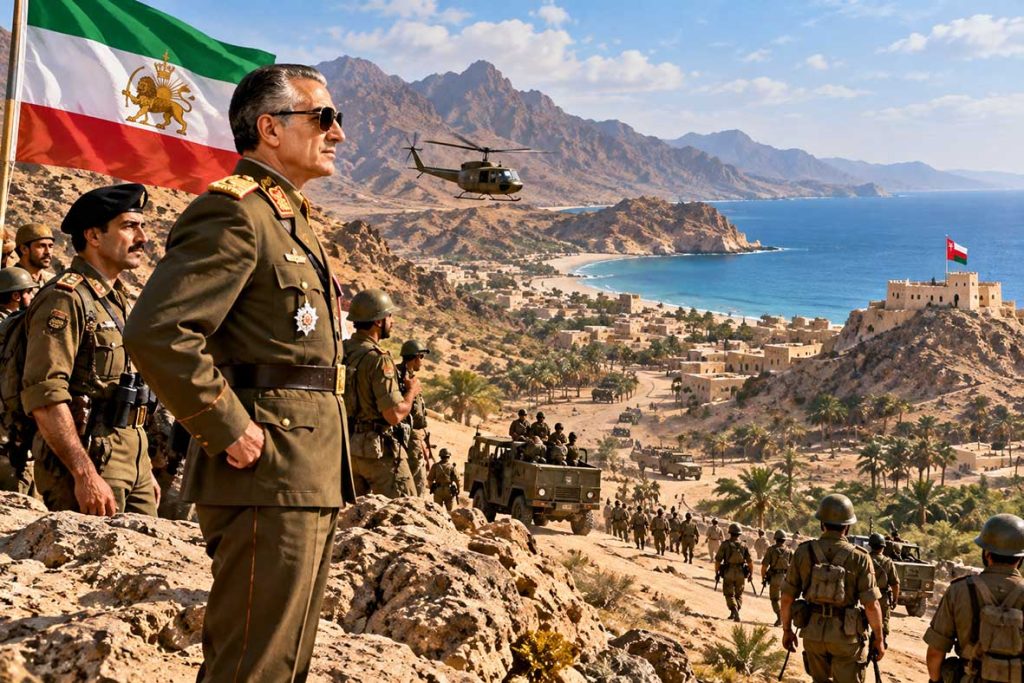
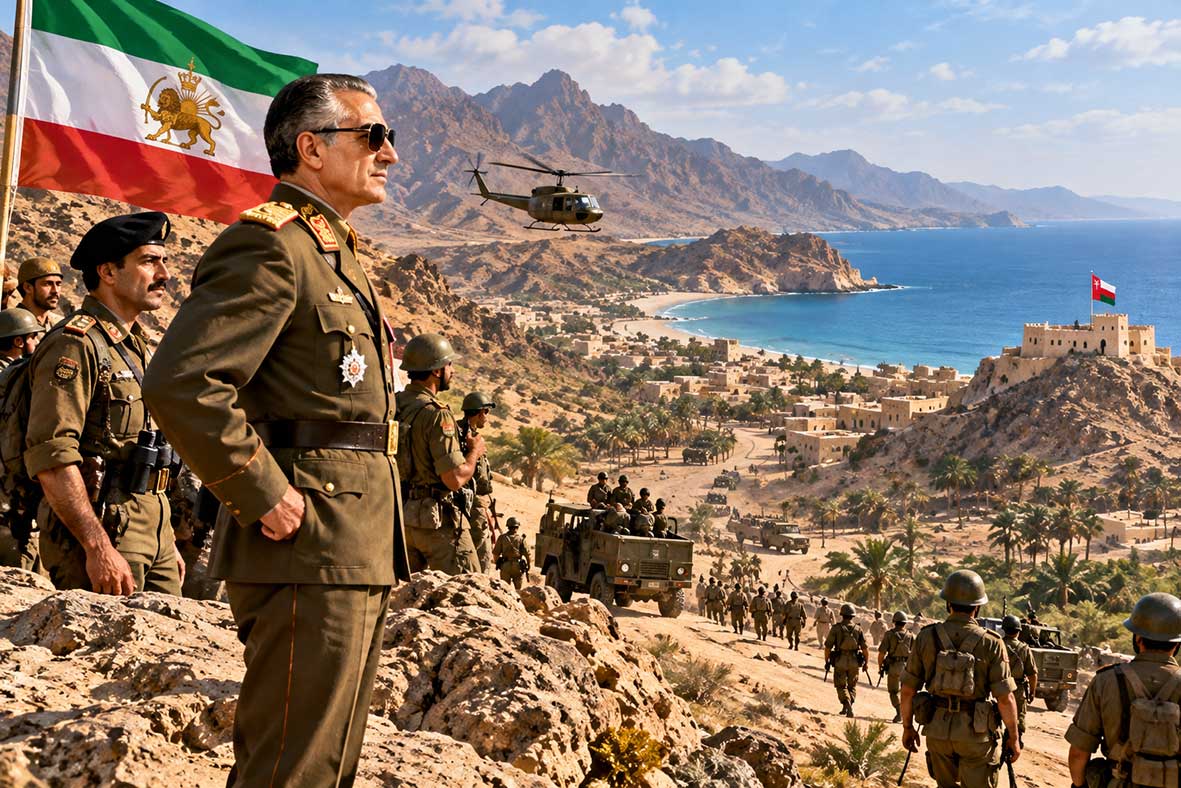
It is worth recalling that during the 1960s and 1970s, a separatist insurgent organization known as the “Popular Front for the Liberation of the Occupied Arabian Gulf,” inspired by Marxist ideology and supported by the Soviet Union and China, engaged in armed guerrilla warfare against the government of Oman.
By 1969, much of Dhofar had fallen under the control of this movement, posing a serious threat to the region. Sultan Qaboos bin Said requested military assistance from His Imperial Majesty Mohammad Reza Shah Pahlavi. The Imperial Iranian Armed Forces, through successful military operations, brought this rebellion to an end in 1975.
At that time, the Himyarites were at times supported by Iran and at other times came under Roman influence. The Abyssinian Empire, which controlled territories along the western Red Sea and the Horn of Africa through the Kingdom of Aksum, played an important role in Arabian affairs approximately a century before the emergence of Islam. The Aksumites converted to Christianity in the fourth century AD and consequently became allies of the Romans.
In the early sixth century, around 520 AD , under the pretext of defending the Christians of Najran, a southern Arabian city near today’s Yemeni border, who had suffered persecution and massacres under Dhu Nuwas, the Jewish king of Himyar, the Abyssinians invaded Yemen and expanded Christianity there. The Sasanians had long competed with Byzantium for influence in Yemen because of its strategic position along the trade routes carrying spices, aromatic woods, and silk from India and China to Europe.
As discussed previously in connection with the changing routes of the Silk Road, the Sasanians could not remain indifferent to the establishment of a Christian stronghold allied with Byzantium in this strategically important region near their maritime borders. Such an occupation threatened to upset the balance of power in the Red Sea.
Several years after this invasion, one of the Abyssinian rulers of Yemen, known as Abraha, attempted to expand the influence of the Aksumite Empire throughout Arabia. He built a magnificent church known as Al- Qullays in Sana’a in an effort to divert Christian pilgrims away from Mecca and its Christian pilgrimage site. This action increased tensions with the Sasanians as well as with the southern Arab tribes.
Khosrow I Anushirvan , who continually sought to establish naval bases to control and weaken his commercial rivals, accepted a request for military assistance from Sayf ibn Dhi Yazan, a Himyarite ruler, at the same time that Abraha launched his campaign to capture Mecca. Consequently, Khosrow dispatched Iranian forces to Yemen around 570 AD.
Before examining the story of Abraha in greater detail, it is necessary to consider the economic and political circumstances of Mecca from a historical perspective. Only then can we understand the conditions under which Islam emerged, how it spread beyond the Arabian Peninsula, and how, within a century, it reached Khorasan (671 AD).
Mecca: A Commercial Hub and Pilgrimage Destination
Since ancient times, the presence of the Zamzam Well made Mecca an important stopping point for merchant caravans. Over time, its commercial significance continued to grow. The existence of the Kaaba also established Mecca as a unique destination during the pilgrimage months. During these sacred months, warfare and bloodshed were prohibited, allowing pilgrims and merchants to travel safely to Mecca, bringing their possessions and merchandise for trade.
To be continued…