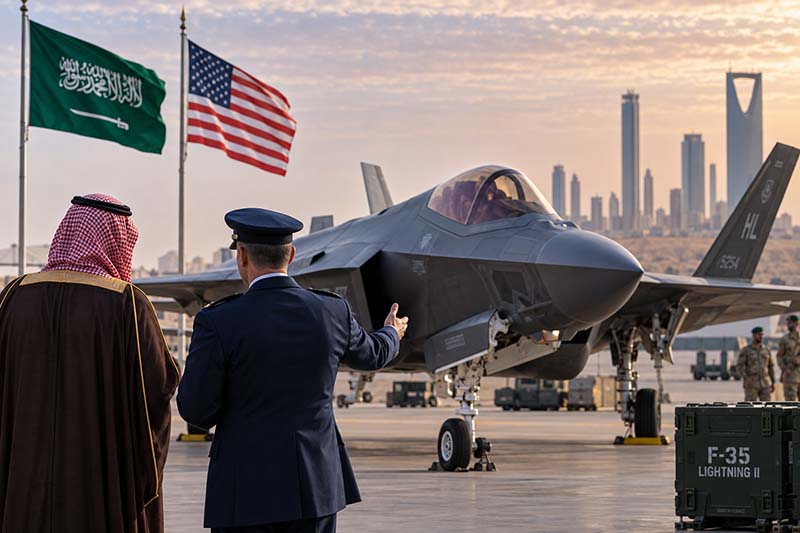


Payam Javan: The United States Department of State has officially announced its approval for the potential sale of Lockheed Martin F-35 Lightning II fighter jets to Saudi Arabia. This significant military agreement, valued at approximately $24.3 billion, comes amid the kingdom’s ongoing efforts to modernize its air force and address evolving regional security challenges. The proposed package encompasses 48 of the advanced stealth aircraft, 49 Pratt & Whitney engines, as well as essential communications equipment, spare parts, and logistical support services.
This development follows a direct appeal made by Saudi officials to the Trump administration earlier in 2025. While the State Department has given its preliminary authorization, the transaction remains subject to final approval by the United States Congress. Lawmakers have historically expressed varying degrees of skepticism regarding arms transfers to the kingdom, citing concerns over human rights records and regional instability, which suggests the deal may face rigorous legislative scrutiny before it can proceed.
The F-35, widely regarded as the world’s most sophisticated fighter aircraft, features advanced stealth technology designed to evade enemy detection. If finalized, this sale would mark a significant shift in regional military capabilities. Currently, Israel remains the only nation in the Middle East to operate the F-35, a status maintained under long-standing U.S. policy aimed at preserving Israel’s qualitative military edge. Ensuring that this edge is not compromised while satisfying Saudi Arabia’s defense requirements remains a delicate diplomatic balancing act for Washington.
Saudi Arabia, already the largest purchaser of U.S. weaponry, views this acquisition as a crucial component of its broader strategy to counter regional threats, particularly from Iran. The Saudi embassy in Washington has publicly lauded the approval, characterizing it as a testament to the enduring strategic partnership between Riyadh and Washington. Officials from the kingdom emphasized that the deal represents a natural progression in their long-term defense cooperation and commitment to regional stability.
Historically, the prospect of supplying F-35s to Saudi Arabia has been closely linked to complex diplomatic negotiations. Previous administrations had explored the possibility of such a sale as a potential leverage point to encourage the normalization of relations between Saudi Arabia and Israel, though those specific diplomatic efforts had previously stalled. The current administration has signaled a renewed willingness to deepen defense ties with Riyadh, prioritizing large-scale arms agreements as a key pillar of its foreign policy agenda.
As Saudi Arabia continues to pursue its Vision 2030 agenda, which includes ambitious plans for military and economic modernization, the kingdom is actively seeking to diversify its defense partnerships while maintaining its primary security alliance with the United States. The potential delivery of these fighter jets would represent a major milestone in this objective. However, the intersection of congressional oversight, regional geopolitical tensions, and the technical requirements of operating such an advanced system ensures that the finalization of this deal will remain a focal point of international scrutiny.