


By: Shardad Khabir
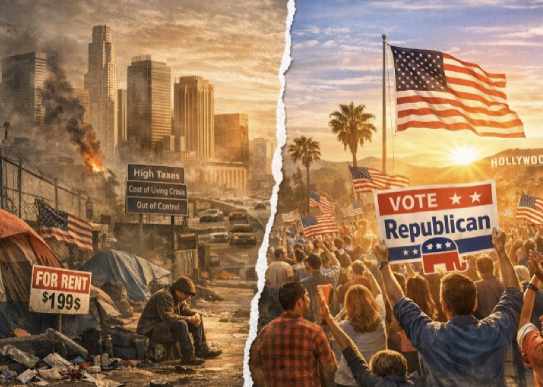
California has long been known as one of the primary strongholds of the Democratic Party—an overwhelmingly blue state whose political, cultural, and demographic structure has consistently favored Democratic candidates. In many election cycles, the margin between the two parties has been so wide that genuine competition seemed unlikely. However, in 2026, a combination of economic, social, managerial, and political conditions has emerged that has led political analysts to speak of “new opportunities for Republicans.” These opportunities do not predict any specific outcome, but they highlight shifts that have made California’s electoral landscape more complex and less predictable. In this environment, Republicans may be able to use economic, security focused, and governance based messaging to attract independent voters and those dissatisfied with the status quo, giving them a stronger presence in the midterm elections.
One of the most significant factors shaping voter behavior is the economic crisis and the pressure of the cost of living. California remains one of the most expensive states in the United States, with housing prices, energy costs, taxes, and everyday expenses reaching levels that place enormous strain on the middle class. Media reports indicate that many families feel current state policies have failed to ease this burden. In such a climate, Republican economic messaging—emphasizing tax reduction, deregulation, and support for small businesses—has become more appealing to a segment of voters. The ongoing out migration from California to more affordable states is another indicator of economic dissatisfaction, and this dissatisfaction can translate into shifts in voting behavior.
Another major factor is the homelessness crisis, which has become one of California’s most visible and persistent social challenges. Despite tens of billions of dollars in spending, the number of unhoused individuals in many major cities continues to rise. This issue has become a central point of criticism directed at state leadership, and many voters feel that existing programs have not delivered meaningful results. Republicans have emphasized the inefficiency of current policies, calling for regulatory reform, stricter oversight of spending, and a different approach to managing the crisis. These messages resonate strongly with voters frustrated by street conditions, public safety concerns, and the perceived failure of state programs.
At the same time, internal divisions within the Democratic Party have added another layer of complexity to the political landscape. A crowded field of candidates, the absence of a unifying figure, and election related controversies—such as the allegations against Eric Swalwell—have weakened party cohesion. Media reports suggest that pressure on Governor Gavin Newsom to intervene in the primary process has increased, yet such intervention risks deepening internal rifts. Analysts describe this moment as one of “erosion of internal unity,” a vulnerability that Republicans hope to exploit through more disciplined messaging focused on economic and public safety concerns.
Another factor that may benefit Republicans is the series of socially and culturally contentious laws passed in California in recent years. Policies such as gender neutral bathrooms in schools, new restrictions on law enforcement, aggressive environmental regulations, and new rules for delivery platform companies have generated mixed reactions. While these laws are supported by many Californians, a significant number of independent and moderate voters feel the policies were implemented too quickly or without sufficient public consultation. Republicans have attempted to appeal to these voters with messages centered on “restoring balance,” “supporting parents,” and “reducing government overreach.”
Concerns about public safety have also grown in several regions. Reports indicate increases in certain crimes, such as retail theft, car theft, and street level offenses. Although official statistics vary across categories, the public perception of declining safety has intensified—and in politics, perception often matters as much as data. Republicans have capitalized on this sentiment by promoting tougher crime policies, stronger support for law enforcement, and reforms to parole and sentencing laws. These messages have gained traction among voters who feel their neighborhoods have become less secure.


