
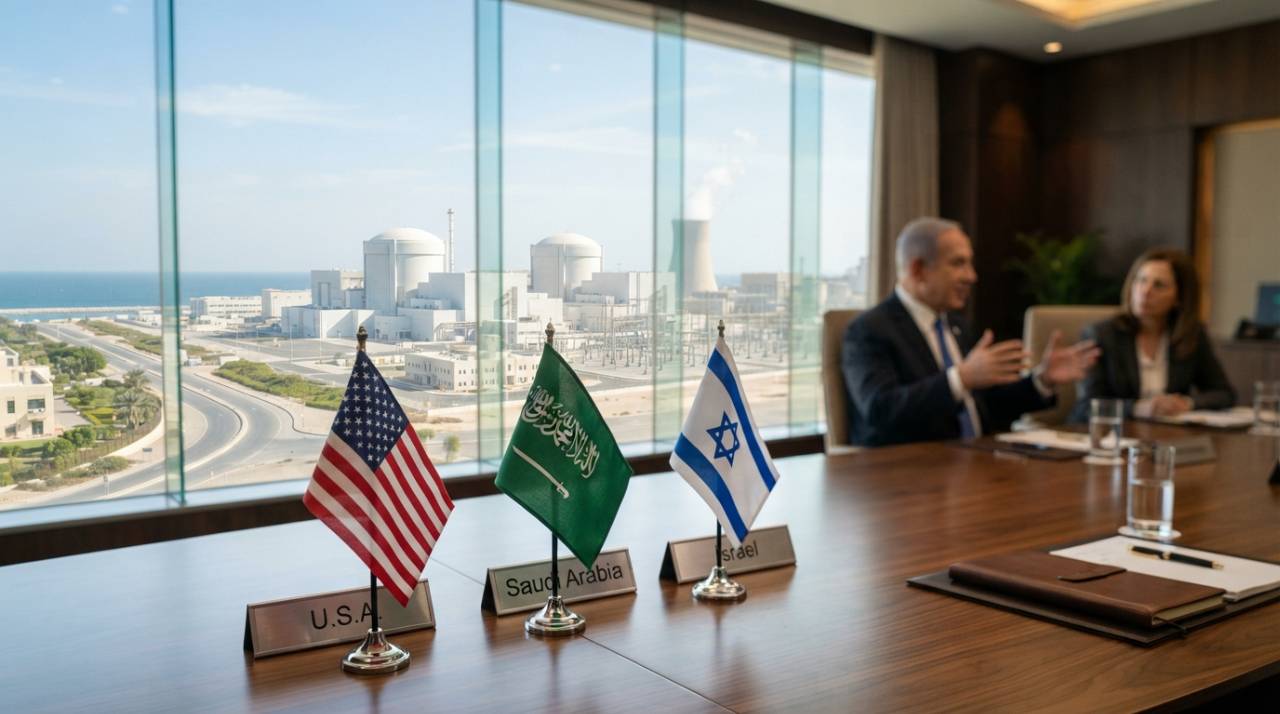


Payam Javan: President Donald Trump has announced that a newly reached civil nuclear cooperation agreement between the United States and Saudi Arabia is strictly conditional on the kingdom normalizing diplomatic relations with Israel under the Abraham Accords. The announcement represents a significant geopolitical maneuver, directly linking advanced energy technology sharing with broader diplomatic realignment in the Middle East.
Under the terms of the proposed bilateral agreement, the United States would permit Saudi Arabia to construct civilian nuclear reactors utilizing American technology. The deal is projected to span 30 years and involve U.S. private sector firms in its development. Notably, the framework does not mandate the immediate, snap United Nations inspections that Washington has historically insisted upon for other regional nuclear programs, such as that of Iran.
Addressing potential security concerns, President Trump clarified that the agreement does not currently permit Saudi Arabia to enrich uranium, stating that the U.S. remains supportive of civil, non-enriched nuclear facilities. However, the deal has drawn scrutiny from nonproliferation experts, who warn that it lacks robust guardrails to prevent the future enrichment of uranium to weapons-grade levels. The proposed framework does, however, leave open the possibility of constructing a uranium enrichment facility in the kingdom following a joint U.S.-Saudi study.
The requirement to join the Abraham Accords presents a formidable diplomatic hurdle for both nations. Riyadh has consistently maintained that formal normalization of ties with Israel remains contingent upon the establishment of a viable pathway toward Palestinian statehood. Meanwhile, Israeli Prime Minister Benjamin Netanyahu has repeatedly signaled that such a pathway is not currently under consideration, setting up a complex diplomatic impasse for the administration’s Middle East strategy.
Moving forward, the agreement must be submitted to the U.S. Congress for formal review. Lawmakers are expected to closely scrutinize the deal’s nonproliferation safeguards, economic benefits for U.S. firms, and its potential impact on regional stability. As the legislative review begins, the administration’s effort to expand the 2020 normalization agreements will likely trigger intense debate among foreign policy analysts and legislators.


