


Interview by Shahrdad Khabir
Steve, thank you for joining Payam Javan TV. California is at a moment where people are hungry for leadership, clarity, and a new direction. I want to use our time today to focus on your vision, your character, and the values that drive you.
Let’s start with the big picture. What is the core vision that motivates you to step into this race, and what do you want Californians to understand about your leadership style?
Well, thank you very much. First of all, it’s wonderful to be with you. It was great to see you the other week. We had a very special day last time we saw each other. It was the last day of Nowruz and we had a wonderful time at the Sizdeh Bedar festival in the park. It was Easter Sunday and I went back home, and then later that evening I found that I’d been endorsed for governor by President Trump. So I will always remember that day. Very fond. Thank you very much for having me here today.
I think that the central point is that this place, California, our home is the most wonderful, the most magnificent place anywhere in the world. It’s the greatest state in the greatest nation on earth, but it’s been completely ruined by the people in charge. It’s 16 years of Democrat, one party rule, this incredible place with all our advantages, natural beauty, weather, great universities, culture, energy, the spirit, the rebel spirit, the startup hustle, all of these great things that we have and yet despite that, we have the highest poverty rate in America, the highest unemployment rate in America, the highest cost of living; US News and World Report ranks California 50th out of 50 states for opportunity WalletHub. We are ranked 50th out 50 for affordability, chief Executive Magazine, 50th out of 50 states for business climate. So on all of these things and many more, we are just doing so badly and so my vision, is to restore California to our glory, to where we should be, which is the best place in America and therefore in the world. ‘Cause we, of course, I hope we all agree that America, yes, is the greatest nation in the world. I’m a proud American moved here in 2012 with my wife and my two sons. So California should be the best place to start and raise a family, the best place to start and run a business to follow your dreams, and we should take all the barriers away from that and support people and businesses in achieving their dreams. That’s what I see as the future for California after I’m elected governor.
Thank you for laying out that vision clearly. I want to go a little bit deeper into a kind of a leader you are. So you built a reputation for being direct, principled and willing to challenge powerful institutions. How has your character shaped the way you lead during high pressure moments?
It’s interesting. I don’t think about that type of thing too much actually. I just do it, you know, and maybe that’s the answer. You just do it and follow your values and your instincts. And you’re right. I’ve always been very direct, but I’ve always been very open and I think it’s very important to understand that in the government. I mean, I have experience in of executive rolls in a wide range of areas. Most of my career has been in business starting and running companies and, working in business all over the world. But I’ve also had experience in the government, in the UK government. I was senior advisor to the Prime Minister for a couple of years before we moved here in 2012. And I know very clearly that, you never achieve anything on your own. It’s always as part of a team. And in fact, as the leader, your most important responsibility is to find good people and put them into the right positions, and then trust them to do their jobs and hold them accountable. That’s what it’s all about. So I’ve always been slightly surprised in politics that you have candidates and they run as if it’s just them. President Trump was different actually, if you see back in 2024, one of the things I really liked about that campaign was he had all these great people around him, Elon Musk, Bob Bobby Kennedy, Vivek Ramas Swami and Vinny Moore. And that’s exactly how I’m approaching this. I’ve putting together a team to run for office with me in California. The other statewide positions you saw them at that event, Gloria Romero running with me for Lieutenant Governor. She’s a former Democrat, former leader of the Democrats in the state Senate. She knows exactly how Sacramento works or doesn’t work. I’m an outsider. I’ve never run for office before. I think we need that. That’s a good balance. Michael Gates running with me for Attorney General. Herb Morgan running for state controller. I’m already looking at the people I’m gonna be putting into leadership positions inside of the government, the different agencies and cabinet positions. So by the time we get to the election in the fall, people will have a really clear sense of the kind of administration that I will be leading.
Well, that perspective on a leadership under pressure is powerful. Let’s connect to your personal journey. What, personal experiences or values push you to run for office this moment in California history?
Well, I didn’t really set out to do this. As I mentioned, most of my career I’ve been in one form or another of executive position doing things, trying to make change happen. And then after we moved here in 2012, I taught at Stanford University, started a tech company. And then very unexpectedly around 2016, was invited to host a TV show on Fox News. I’d never done anything like that before. Of course, it was a great honor. I very much appreciated it. I hosted a show for a number of years on Sunday nights, on Fox News, the next revolution. But actually as the years went on, I wanted to get back a little bit to doing things, not just talking about things. And because I love California so much, I’ve made my life here, raised my family here, became an American, started a business here, and so, I wanted to do something for California that’s practical, not just complaining but actually solving problems. And so I started an organization, a policy focused organization called Golden Together three years ago. And I’ve been traveling the state and listening and learning and developing detailed solutions to our problems. But the thing is, when I started that journey, I wasn’t saying I’m gonna run for governor, but as I got more involved in understanding how things work in California, I realized that they really don’t work, especially in Sacramento. And I started talking with legislators and I saw this whole system that we’ve got completely broken, totally corrupt; you have the unions and the climate change extremists and the far left activists and a lot of the lobbyists totally control the government. And as the years went on, I just thought, you know, I can’t stand this anymore. I’m gonna have to actually go and see if I can do something about it myself.
Well, I appreciate you sharing that. Now, let’s look forward; if you are elected, how do you believe the future of the California will look different under your leadership, and what changes do you hope people will be able to feel in their daily lives?
There’s a simple way of thinking about that, which is just liberation, freeing us from the restrictions of this bloated, nanny state, bureaucratic government that we have. And so let’s think about the specific things. The regulations will be lifted from our businesses that the spending of the government will be brought back to a sensible level and taxes will be reduced. The water will be flowing to our farmers. The oil will be flowing to our refineries so that gas prices can come down, the forests will be properly managed, so we can harvest the timber and have lower cost construction materials to build the homes, the single-family homes. That young people want to start and raise a family. All these practical things and many, many more. But it all comes down to the same thing, which is just giving people the opportunities that they should have to follow their dreams. The California dream.
Well, that’s a compelling picture of what’s possible. Let’s, turn to one of the biggest challenges families face every day. Across the state, families are struggling with affordability. From your perspective, what are the most urgent steps needed to make life livable in California again?
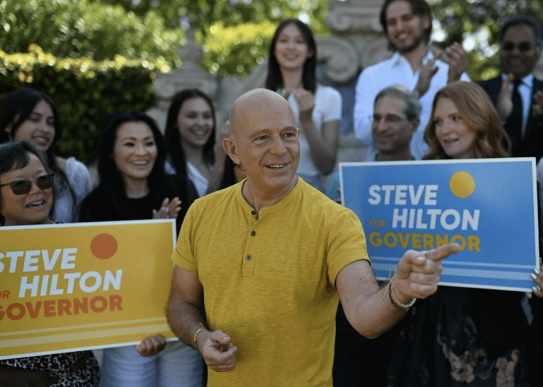
Well, funny enough, the whole theme of my campaign, if you look at the town halls we do up and down the state, we got a bunch of them this weekend that I’m speaking to you, and there’s a banner at the back behind me that has the theme of the campaign and it’s, we can say it in one word, Cal-affordable. That’s my plan to make our state Cal-affordable. And then the specific items, we are gonna end the Democrat’s climate dogma. So we can have, instead of 5, 6, 7, $8 gas, $3 gas. We’re gonna use natural gas for power generation so we can cut your electric bills in half. We can cut out the fraud and the waste in the government, so we cut spending, your first a hundred grand tax free. We’re gonna end free healthcare for illegal immigrants so that we can reduce healthcare costs for Californians, and we’re gonna get rid of the ridiculous regulations on building everything so that we can restore the California dream of a home you can afford to buy. That’s the plan, Cal-affordable.
Wonderful affordability touches everyone, and your approach gives people hope. Another issue people talk about constantly is about safety. So, public safety remains a major concern in many communities. What approach do you believe will restore a sense of security and trust for California?
Remember that law enforcement and criminal justice policy, this is very much public safety, it’s very decentralized. You have sheriff’s departments and police departments and mayors and a lot of different local organizations involved in fighting crime, and that’s correct. So I focus on what can we do at the governor level? What’s the state’s role here? Top of the list: is prisons because since Jerry Brown, actually more than a decade, they’ve been accelerated under Gavin Newsom, they’ve been shutting down state prisons. Tens of thousands of dangerous, violent criminals released either directly into the community or transferred to county jails where they’ve become very overcrowded. And so at the local level, the courts know that the jails are full so no one gets sent to jail. And so the law enforcement is undermined because they think, what’s the point in enforcing the law if nothing ever happens, there’s no consequence. I’ve heard law enforcement describe it as revolving door catch and release. So all of that is a disaster. And so we have to start by really recognizing that and my plan, which I published last summer, is to stop the prison closure program and increase prison capacity in California so that we can make sure that criminals are held accountable. The dangerous, violent criminals are behind bars. Where we can offer them both the punishment that they need to hold them accountable, but also the rehabilitation so that we actually reduce crime and reduce the re-offending. So the centerpiece of what I would do is to increase prison capacity in California by lot, but then we also have to look at some of these laws and work with the legislatures. I mean, we’ve had so many terrible state laws that have got in the way of law enforcement, whether that’s Prop 47, prop 57, you’ve got these, there’s a massive explosion in what they call mental health diversion, where criminals use the excuse of mental health. But you, they use this mental health diversion to escape accountability. So there’s a lot of things that we need to change in terms of state law, but that’s harder because you have to work with the legislature to do that, and it’s controlled by the Democrats. But I think everybody sees that it’s gone too far and we’ve got a lot of allies, I think, to try and make the changes needed. But the prison club, the prison program that is directly under the governor’s control and the parole system, all of that, that we, we can have a much tougher attitude to crime and punishment in California when I’m governor. Absolutely restoring trust and security is essential. Another area where people are asking for a real change, is education. You have spoken often about the need of education reform. What is the single most important change you believe would improve outcome for California’s students?
Well, I’ll answer that a couple of different ways. So, long term, the most important change is to end the government school monopoly and to break the power of the teacher unions. They’ve been so destructive and long term, I’ve always been a strong advocate for school choice, where you put the power in the hands of the parents to choose the best school for their kid, and then that will create a diverse supply of different schools offering different kinds of education. You know, some kids may do better in a large school, some of them in a small school, some of them more academic, some of them more skills based and vocational and etc. Children are different. I know that from my two sons, they’re very different. And, so we shouldn’t have this kind of one size fits all model of schools. But that’s the single biggest thing in the long term. In the short term we have to help. It takes a long time for that kind of thing to kick in when you have a structural reform program like that, you see it in other states and it’s great what’s happening, but it takes a long time. So what can we do immediately to help kids that are in school today, in California, that are in these terrible failing public schools? You’ve got now less than half the kids in California public schools can read at basic grade level. With math, it’s 35%. It’s a total disaster. And so there’s some simple, practical things we can do right away when it comes to reading, there is a methodology for teaching, reading, a technique for instruction with reading that works. Debate around this was settled decades ago, but it’s not used much in California. It’s called phonics. It’s a particular technique for teaching reading that we don’t really use in most of our California schools because the public school system has been captured by far left ideologues in the teacher union. So, we gotta use phonics to teach kids to read. We gotta learn from other states doing things well. For example, in the last 10 years, you look at states like Mississippi and Louisiana have massively, improved their education. They’re far ahead of California now on education results. And one of the ways that they’ve done that is to focus on reading. People say that up till third grade you learn to read, and after third grade you read to learn. In other words, if you can’t read, you can’t learn. And so, they put a tremendous focus on reading by the end of third grade, this is in Mississippi. If you don’t pass the standard that’s required by the end of third grade, they give you some training, help in the summer and they test you again. If you don’t make it, you repeat the year. They don’t let you move forward. If you can’t read. It’s had hugely positive results in Mississippi and other states. So, that’s what we need here. And then finally, we’re gonna hold schools and teachers accountable because right now it’s very difficult to find out which schools are doing well, which teachers are doing well. But the information is there, it’s just hidden from parents. And so, we’re gonna publish that information in a very simple way. A grade for every school, a grade for every teacher, so we can reward the good ones and remove the bad ones.
Well, clearly education shapes the future and your focus on outcomes is important. Let’s talk about issues that affects every community in a visible way. Homelessness. I think that’s a subject that is so important for all of us and it helps the safety of the community, which is the most visible and heartbreaking issue in the state. What strategy do you believe California has not tried or not seriously done it enough?
Well, they haven’t tried. I mean, they just keep spending more and more money and the problem gets worse. It’s a disgrace. It’s a scandal actually, that they’ve let this develop for so long and done nothing about it. And even when they sort of try and intervene, they’re really just moving people from one place to another. The numbers of homeless people just go up. Let’s just be clear, the starting point is; there’s a three-point plan I have. The starting point, it’s all illegal. Homeless encampments are illegal. It’s illegal to sleep on the streets, and yet nothing’s done about it. So, the first step is we have to enforce the law. We have to actually use law enforcement to remove people from the streets. We would never allow, people we love to live in those conditions, So why should we accept it for anybody else? We will if it’s local, Politicians won’t do it, as governor, I will use state law enforcement resources to remove homeless encampments. That’s it. Number two, we have to get people into the treatment that they need. Over 80% of homeless people have severe mental health problems or drug and addiction problems. We used to have a situation where you had a choice, rehab or jail. We’re gonna bring back that choice. You have to get clean. We can’t have this attitude where it’s your choice If you are homeless and you’re gonna receive government services that you can choose not to get sober and clean, that shouldn’t be a choice. And then the third is mental health, where we’ve got so many people who have very severe mental health problems, basically being treated in county jails. It’s barbaric. So, we have to increase mental health capacity by taking the money out of the homeless industrial complex, all that taxpayer money that’s ended up in the pockets of nonprofits and crony developers. We’re gonna put it into mental health capacity, including making some changes to the Medicaid rules so that we can get federal matching funds, and then we can deal with the problem and the, and the strategy should be to end homelessness not to reduce it by a little bit; just to stop this scandal. You don’t see it in other states and I as governor, I’m gonna make sure we don’t see it here.
Thank you for addressing that with such clarity. California is also home of a diverse immigrant communities who want to feel seen and included. California is also home of Iranian Americans, Okay, which includes me. How do you plan to engage these communities, and ensure their voices help shape the future state of California?
Well, you know, I’m a legal immigrant. I’m the only candidate running for governor who is an immigrant, and I have, I say often I am the candidate of the legal immigrant community for the legal immigrant community. In fact, I’m an immigrant twice over because my parents were refugees from communism in Hungary and I was born in England. And then, we moved here 2012 with my wife and my family. So I deeply understand the aspiration of immigrant families. I grew up in a working class, immigrant family in England. My dad, my stepdad worked construction. He was Hungarian as well. Everybody’s Hungarian in my family. My mom worked in a shoe store. We worked hard. I got to Oxford University, worked in business, did very well. Came here, so that story of climbing the ladder of opportunity. That is what the immigrant story is about. And that is my story. And so I deeply understand that. And I want that for every immigrant community in California, every legal, immigrant community. And I’m a particularly, feel close to the Iranian community I’ve met, you know, ever since we’ve been here. Some of my closest friends in the Bay Area have been from Iran originally, and I’ve really got to understand and know that community. I feel very, very close. And you are gonna have a very strong friend and partner when I’m governor.
Appreciate that. Thank you for sharing your perspective. I personally am proud of you. Thank you for all that you are doing, and I look forward seeing you as a governor next time we meet in November. California Looking for clarity and leadership and conversations like this will help people understand the person behind the campaign and I’m very thankful of you today joining us in Payam Javan TV.
Wonderful to be with you. Thank you so much. Thank you. Take care.


