

By: Shardad Khabir
The heavens darkened when that green giant fell to earth;
Cries and lamentations echoed through the celestial dome.
The garden grew ill, and the tulip slipped into eclipse;
The pomegranate tree trembled, and fever seized the vine.
Minstrels sang The Vengeance of Siavash through the streets,
For that tall and noble figure had fallen to the ground.
Mothers! Wailing, tearing your hair and rending your garments—
What evil fate has brought us once again beneath Zahhak’s hand?
The towers and ramparts of ancient Nishapur were shaken,
By the earthquake that this tragedy unleashed upon the land.
— Mohammad-Reza Shafiei Kadkani
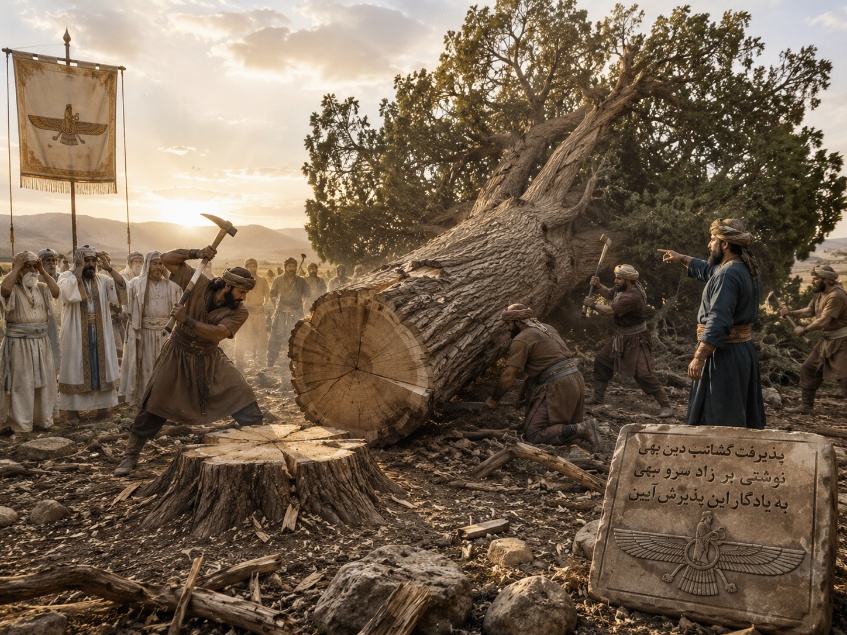
When Zoroaster brought King Vishtaspa of Iran to accept his faith, he commemorated the event by planting a cypress tree in Kashmar . According to tradition, Zoroaster had brought the tree with him from Paradise and planted it there:
He brought a branch of cypress from Paradise,
And planted it at the gateway of Kashmar .
Upon the trunk of this noble cypress, Zoroaster is said to have inscribed a memorial to Vishtaspa’s acceptance of the faith. The tree consequently acquired a sacred status among the people. It remained standing for centuries, eventually becoming so immense that, according to Ferdowsi, even a long fortress-scaling rope could not encircle its enormous trunk.
There stood a noble cypress brought from Paradise;
Before the Fire Temple, he planted it.
Upon the tall cypress he inscribed these words:
“Vishtaspa has embraced the righteous faith.”
This was the celebrated Cypress of Kashmar , a tree that holds an honored place in Persian literature and was considered sacred by the Behdins —followers of the Zoroastrian faith.
It is said that al-Mutawakkil, the Abbasid caliph (207–247 AH), decided that the trunk of the cypress should be used for the roof of a great hall he was constructing in Baghdad. The Zoroastrians offered the caliph enormous sums of money to spare the tree, but he refused to abandon his decision.
They warned him that the tree was sacred and that cutting it down would bring misfortune upon whoever ordered its destruction, as well as upon those who participated in the act.
But al-Mutawakkil, intent upon uprooting Iran’s ancient culture and beliefs, humiliating its people, and demonstrating his own power, ordered Abu al-Tayyib Tahir, the governor of Nishapur, to carry out his command.
The governor undertook the grim task, and the ancient cypress was felled.
When that enormous and venerable tree crashed to the earth, thousands of birds’ nests hidden among its dense branches were destroyed. The cries of the birds rose into the air. The vast canopy that had provided shade and refuge from the burning sun for countless people and animals in that arid land disappeared. It seemed as though the blessing of the place itself had vanished.
It took a long time merely to cut apart its branches and prepare its massive trunk for transportation. With immense difficulty, the pieces were loaded onto numerous wagons and carried toward Baghdad.
But when the caravan finally reached Baghdad, fate had already intervened.
That very night, Turkish guards killed al-Mutawakkil while he was engaged in an evening of revelry. He never lived to see the massive pieces of the cypress whose destruction had uprooted a symbol of hope and left so many Iranians in grief.
It is further said that Tahir, the governor of Nishapur, along with the carpenters, blacksmiths, apprentices, spectators, and those who transported the timber, ultimately met their own deaths as well.
The cypress has, since ancient times, been one of the enduring symbols of Iran. Its frequent appearance in the reliefs of Persepolis, as well as in curtains, textiles, and Persian carpets—sometimes standing straight, sometimes with its upper branches gracefully bent—is a surviving expression of this ancient national tradition.
The cypress may also be seen as a symbol of the Iranian nation itself: battered by the storms of history, bent slightly beneath the oppression of domestic rulers and the assaults of foreign invaders, yet never broken—still alive, upright, steadfast, and proud.
Thousands of ancient cypress trees can still be found throughout Iran, in cities and villages and particularly in the cooler highland regions. Such venerable trees have traditionally been referred to as Jamshidi trees.
For years, however, one troubling question has occupied my mind: How was it possible that, during the earliest years of Islam and only a short time after the Arab invasion of Iran, these desert tribesmen appeared as far away as the northernmost reaches of what was then Greater Khorasan?
And how did it happen that, for centuries afterward, the political center of gravity of Iran shifted away from the western and southern regions—particularly the province of Fars—to the far eastern reaches of the Iranian world: Khorasan and Khwarazm in Central Asia?
It is worth recalling that the Battle of Qadisiyyah took place in 15 AH , while the Battle of Nahavand —the so-called “Victory of Victories,” at least from the Arab perspective—occurred in 21 AH .
Qadisiyyah was fought near present-day Kufa in southern Iraq, roughly one hundred kilometers from Ctesiphon, the Sasanian capital. The area was then known as al-Hirah and had a substantial Arab population, a circumstance that provided the Arab forces with a strategic and military advantage while placing the Iranian army at a disadvantage.
Yet the distance from Kufa to Marv exceeds two thousand kilometers. At the time, this vast territory lay across the Iranian world and was populated overwhelmingly by non-Arab peoples.
Considering the relatively small population of the Bedouin Arabs at that time, as well as the simultaneous Muslim military campaigns against the Romans in the Levant, the conquest of Greater Khorasan, which was substantially completed by 32 AH —barely a decade after Nahavand —is a development deserving serious examination and research.
My point is that a military expedition across such an enormous distance, requiring sufficient manpower, equipment, supplies, transportation, and logistical support, should from the outset have appeared extraordinarily dangerous, if not futile.
Consider, by comparison, Napoleon’s invasion of Russia in 1812.
Napoleon marched with an army numbering roughly half a million men. Yet he was compelled to disperse and station a substantial portion of his forces along a route of less than one thousand kilometers, from his starting positions near the northern borders of present-day Poland and Prussia deep into Russian territory. These forces were needed to protect supply lines, maintain communications, and prevent encirclement or surprise attacks.
Despite possessing military organization, command structures, equipment, and logistical capabilities far more advanced than anything available in the seventh century, Napoleon was unable to remain in Moscow after capturing it.
Hunger, bitter cold, disease, and continuous Russian harassment forced his retreat. Only a fraction of the army that had entered Russia survived the disastrous campaign.
Nor was Napoleon able to leave behind any lasting French administrative structure in Russia—no functioning taxation system, security apparatus, or puppet government through which French authority could be exercised and resistance suppressed. Yet these are among the most fundamental requirements of any conquering and occupying power that intends to retain control over a defeated territory.
With this comparison in mind, I now turn to the Arab presence in Khorasan, contrasting it with what the Mongols did in Bukhara some six centuries later.
Ata-Malik Juvayni relates in his History of the World Conqueror that a man who had escaped Bukhara after the Mongol invasion was asked what had happened to the city.
His answer was devastating in its simplicity:
“They came, they uprooted, they burned, they killed, they plundered—and they left.”
It was said that men of wisdom agreed that no more concise description of the catastrophe could be expressed in Persian.
But the Arabs, the author argues, came and uprooted, burned, killed and plundered—yet they did not leave.
And their presence and influence continued for fourteen centuries.
In the author’s polemical view, that long domination also transmitted destructive patterns—bloodshed, plunder, hypocrisy, informing on others, deceit, and fratricidal conflict—into Iranian political and social life. He argues that, whether openly or beneath the surface, echoes of those patterns remain visible even today. To be continued…
…to be continued