


By: Shardad Khabir
Continuing last month’s editorial, in which I examined why the Arab advance eventually reached northern Khorasan and one of its long-term consequences—the gradual displacement of Iran’s political center of gravity from its greener and more prosperous western regions toward the more arid and sparsely populated east—I will now turn to Arabia itself: its geography, economy, tribal structure, patterns of subsistence, and the political environment from which the Arab-Islamic power ultimately emerged.
The Arab conquest of Iran and the establishment of Arab power in Khorasan opened a new chapter in Iranian history. In later centuries, successive Turkic and Mongol pastoral and nomadic powers also entered the Iranian political arena. These societies had developed largely outside the urban institutions of the great settled civilizations. Life in the steppe and desert—constant movement in search of water and pasture and the physical demands of pastoral nomadism—produced formidable mounted warriors and populations accustomed to hardship.
With the exception of several important native Iranian dynasties, much of Iran’s post-Islamic political history until the modern period was dominated by dynasties of Turkic or Turco-Mongol origin. Military force, religious legitimacy, taxation, tribute, confiscation, plunder, and repression appeared repeatedly among the instruments through which power was acquired and maintained.
The same historical process eventually turned upon the Arab caliphate itself. As the caliphs accumulated immense wealth and Baghdad became a center of imperial luxury, Turkic slave-soldiers, commanders, and military establishments acquired increasing influence over the caliphal state. In later centuries, the Ottoman Turks ruled vast Arab territories—from Syria and Arabia to Egypt and North Africa—under an imperial order that ultimately claimed the mantle of the Islamic caliphate.
In Iran, meanwhile, much of the administrative continuity, literature, scholarship, architecture, taxation, finance, and statecraft that survived successive conquests depended heavily upon Iranian bureaucrats, viziers, secretaries, accountants, scholars, and established administrative families. Elements of the sophisticated bureaucratic traditions inherited from Sasanian Iran survived because these men continued to administer states whose military rulers were often of foreign origin. Some paid for their service, political ambition, or loyalty with their lives.
Introduction
Empires before the modern age frequently emerged according to a recognizable pattern. A militarily powerful force could arise from the margins of established civilization—from tribal, pastoral, or nomadic societies that had previously occupied little space in the calculations of the great powers.
Such forces became particularly dangerous when established empires were exhausted by war, internal division, economic disruption, or struggles over succession.
Examples of this pattern can be found across Eurasia—from China and Mongolia to India, Iran, Mesopotamia, and the Mediterranean world.
The rise of Arab-Islamic power must therefore not be treated as though it suddenly emerged from a historical vacuum.
Islam did not appear in an empty Arabia.
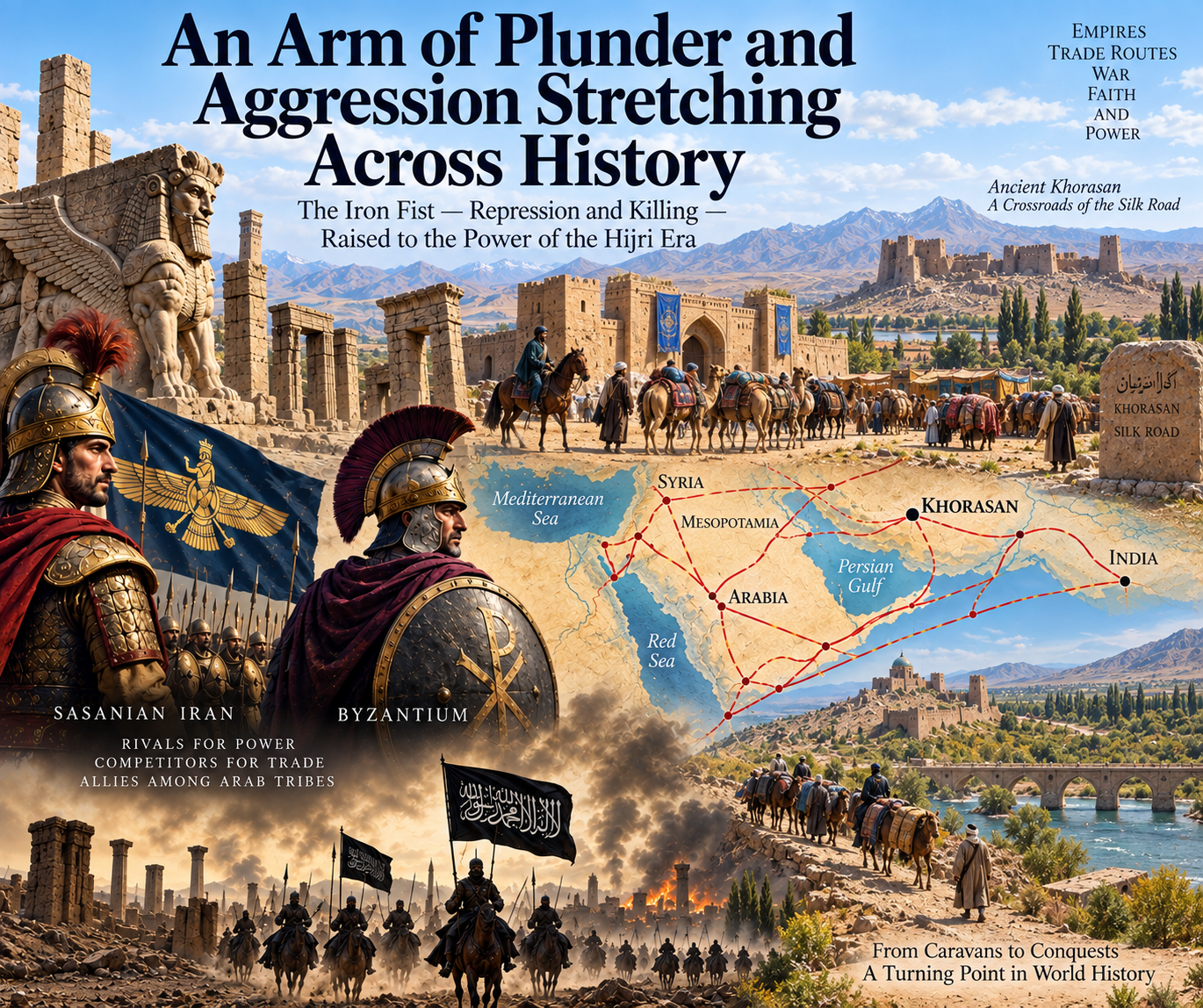
Long before the first Islamic conquests, Arabia and its surrounding territories had become entangled in the great geopolitical struggle between Sasanian Iran and the Eastern Roman, or Byzantine, Empire. Arab tribes and kingdoms were already being used as military allies, frontier buffers, commercial intermediaries, and instruments of influence by both great powers.
To understand how an Arab empire became possible, therefore, we must examine two successive developments: the rise of Mecca and the rise of Islam.
We must also examine what surrounded them: the political economy of Arabia, competition over commerce, the strategic importance of Yemen and the Red Sea, the Persian Gulf, the Arab client kingdoms, and above all the devastating wars between Iran and Byzantium.
Those wars would eventually leave both great empires dangerously exhausted precisely when a new military and political power was consolidating in Arabia.
Before Islam: Arabia Between Two Empires
For centuries, Iran and Rome competed for territory, influence, taxation, commerce, and strategic routes connecting Asia with the Mediterranean.
Arab tribes were not merely spectators to this confrontation.
The Lakhmids of al-Hira were closely associated with Sasanian Iran and served as a defensive barrier along Iran’s southwestern approaches. On the opposing side, the Ghassanids were allied with Byzantium and performed a similar function along Byzantine Arabia and the Syrian frontier.
Arabia was therefore already incorporated into the strategic architecture of the Iranian-Roman conflict before Islam.
The great powers did not simply fight one another with Persian and Roman armies. They cultivated allies, subsidized tribal leaders, established spheres of influence, and used neighboring Arab forces to protect frontiers and exert pressure upon their rivals. Continues …


