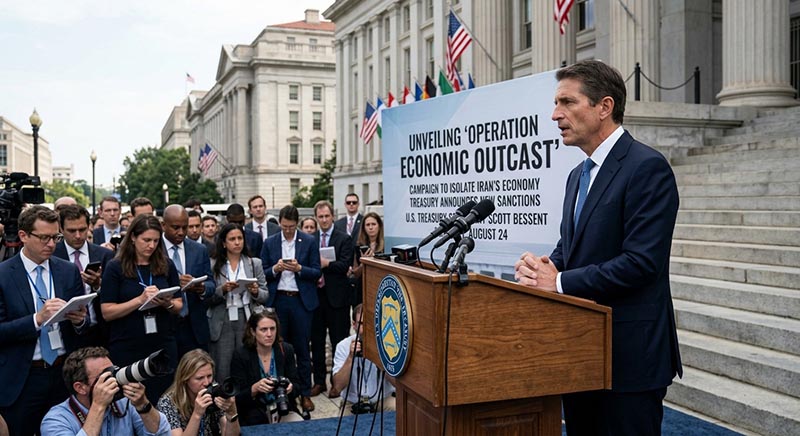


Payam Javan: United States Treasury Secretary Scott Bessent has announced a comprehensive economic campaign, labeled “Operation Economic Outcast,” aimed at further isolating the Iranian economy. Speaking at a news conference, Bessent outlined new measures targeting nearly 60 entities, individuals, and vessels linked to Iran’s oil, nuclear, missile, and cyber networks. The initiative represents a significant expansion of Washington’s sanctions authority, designed to disrupt Tehran’s global financial connections and curtail its revenue streams.
Under the new framework, the U.S. Treasury has issued five sectoral determinations, enabling sanctions against any individuals or entities operating within Iran’s technology, digital assets, gold, aviation, and shipping industries. Furthermore, the administration has intensified secondary sanctions risks, warning international financial institutions and foreign corporations that continued transactions with Iranian entities could result in their exclusion from the U.S. dollar-clearing system. The Treasury has also suspended several general licenses that previously facilitated academic exchanges, cultural programs, and specific financial remittances.
A primary focus of these secondary sanctions is China, which currently purchases approximately 90 percent of Iran’s crude oil exports, primarily through independent refineries and non-bank intermediaries. Bessent emphasized that the Treasury has mapped Iran’s oil smuggling networks and warned Beijing and other global partners not to test American resolve. This development comes ahead of a scheduled meeting between U.S. President Donald Trump and Chinese President Xi Jinping, potentially complicating ongoing bilateral trade negotiations.
The sanctions come amid severe economic distress in Iran, where annual inflation reached 88 percent in July and the national currency, the rial, recently fell to a historic low of nearly 1.4 million against the U.S. dollar. Iranian President Masoud Pezeshkian acknowledged the significant economic strain and the country’s ongoing difficulties in attracting foreign investment. Meanwhile, Mohsen Rezaee, secretary of Iran’s Supreme National Security Council, warned that Tehran would view participation in the economic campaign as an act of war and threatened to block oil transit through the strategic Strait of Hormuz.
While aiming to pressure Tehran, the escalating geopolitical tensions have also contributed to economic challenges within the United States. Global crude oil prices have remained elevated around $80 per barrel, leading to higher retail fuel prices and contributing to a rise in U.S. consumer inflation to over 3 percent. Additionally, upward pressure on long-dated government bond yields has prompted the Treasury Department to double its debt buybacks in an effort to stabilize the financial markets.
In tandem with the financial measures, the Treasury’s Office of Foreign Assets Control has issued advisories to the global maritime industry, urging shipping operators to resist Iranian demands in the Strait of Hormuz to avoid triggering expanded maritime sanctions. The current administration’s aggressive posture follows months of joint U.S.-Israeli operations and repeated warnings directed at the Iranian government. Bessent indicated that further actions, including a major sanction against a specific financial institution, are expected to be announced imminently.
The implementation of Operation Economic Outcast leaves international businesses and foreign governments with critical strategic choices as the U.S. tightens its enforcement mechanisms. With the administration signaling limited patience for sanctions evasion, the coming months will test the resilience of Iran’s alternative trade networks and the willingness of major economies like China to navigate the heightened regulatory risks. The unfolding economic standoff continues to shape broader diplomatic relations and energy market stability across the Middle East and globally.