
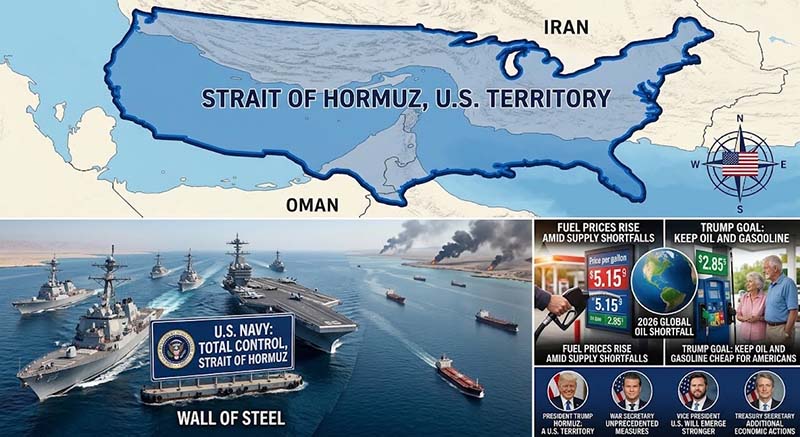


Payam Javan: U.S. President Donald Trump has announced his intention to declare the Strait of Hormuz, one of the world’s most critical maritime transit points, as United States territory. Speaking at the David S. Mack Center for Training and Intelligence in Nassau County, New York, Trump stated that the declaration would follow what he described as the ongoing defeat of Iran. The announcement marks a significant escalation in geopolitical rhetoric surrounding the strategic waterway, which has been a focal point of intense international friction.
The Strait of Hormuz, which previously carried approximately one-fifth of the world’s global oil supply, has seen shipping traffic decline dramatically since the outbreak of conflict involving the United States, Israel, and Iran on February 28. Following the onset of hostilities, Iran largely closed the passage, prompting the United States to establish a naval blockade around Iranian ports. Trump asserted that the blockade has given the U.S. total control over shipping through the strait, a claim supported by War Secretary Pete Hegseth, who maintained that the military has the capability to sustain the blockade indefinitely.
Tehran has strongly disputed Washington’s assertions of control over the strategic waterway. Iranian officials maintain that the Strait of Hormuz remains under the sovereign jurisdiction and management of Iran. The conflicting claims highlight the severe diplomatic and military standoff between the two nations, raising concerns among international observers regarding maritime law and the potential for prolonged conflict in the Persian Gulf.
The disruption of transit through the strait has sent shockwaves through global energy markets, leading to increased volatility and rising crude oil prices. Major energy exporters in the region, including Saudi Arabia, Iraq, Kuwait, the United Arab Emirates, and Qatar, rely heavily on the passage to deliver oil and natural gas to international buyers. The International Energy Agency (IEA) has warned that the prolonged closure and blockade could culminate in a substantial global oil supply shortfall by 2026 if diplomatic resolutions are not achieved.
Addressing the broader military campaign, President Trump acknowledged the extensive use of military force but defended the pressure on Tehran as a necessary measure to prevent Iran from developing nuclear weapons. Vice President JD Vance reiterated this stance, framing Washington’s primary objectives as securing affordable energy for American consumers and neutralizing Iran’s nuclear ambitions. Vance expressed confidence that the United States would ultimately emerge from the conflict in a stronger geopolitical position.
In tandem with military operations, the U.S. administration is preparing to intensify financial pressure on Tehran. Treasury Secretary Scott Bessent announced that the United States is drafting unprecedented economic measures designed to further isolate Iran, with additional details expected to be unveiled next week. As the blockade persists and diplomatic avenues remain constrained, the international community continues to monitor the situation closely, fearing wider economic and security ramifications.


