

Payam Javan: U.S. President Donald Trump has pointed to a recent surge of migrants entering Spanish territory as a warning of what could happen to the United States under different political leadership. Addressing reporters, Trump argued that the events in Europe highlight the consequences of weak immigration enforcement, asserting that a similar situation could unfold in the U.S. within the coming years if border policies are not strengthened.
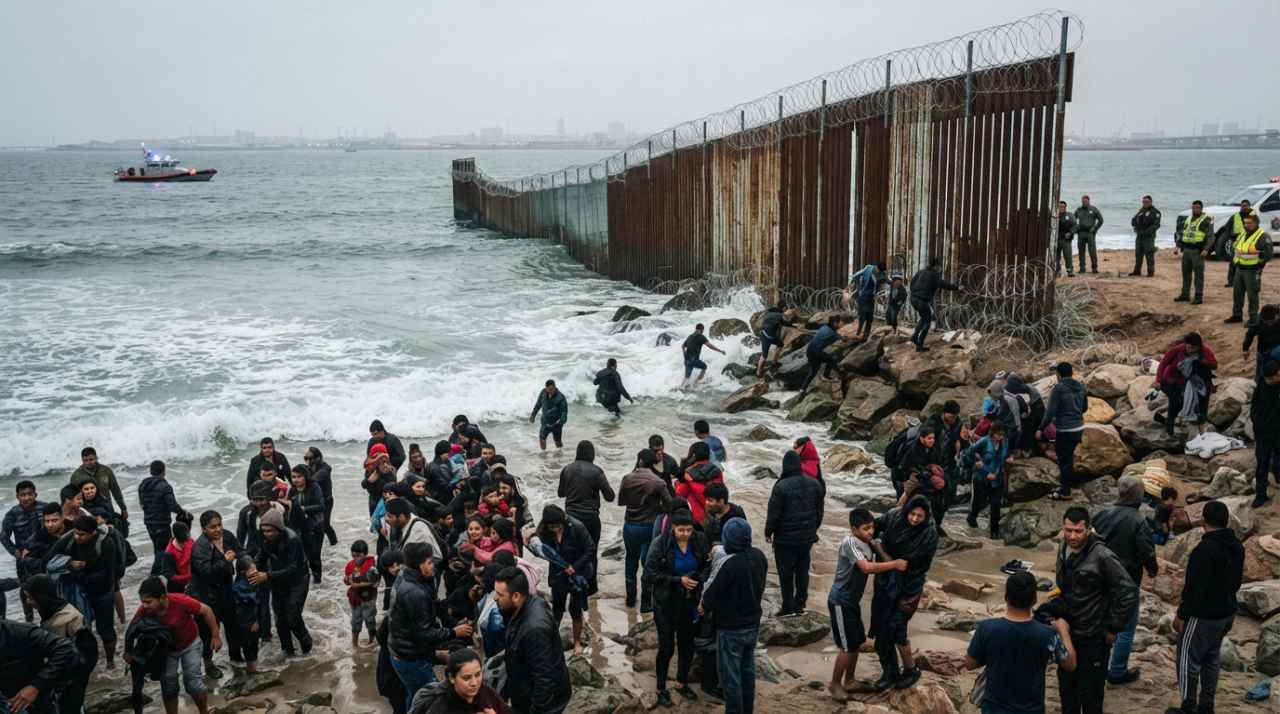
The warnings followed a massive migration event in Spain’s North African exclave of Ceuta, where approximately 60,000 migrants crossed from Morocco within a 24-hour period. Images from the border showed crowds swimming around frontier fences, scaling barriers, and rushing toward reception facilities, with authorities confirming that at least 57 migrants died during the dangerous journey.
Describing the situation as resembling an “invasion,” Trump warned that the United States could experience even higher levels of unauthorized crossings if Republicans do not hold office. He urged observers to remember the images from Ceuta, framing the incident as a precursor to potential domestic border challenges if immigration control remains a partisan battleground.
The U.S. State Department echoed these concerns, releasing a statement that placed the blame directly on the Spanish government. The department characterized the surge as an egregious violation of sovereignty and human rights, attributing the crisis to what it described as deliberate efforts by Spanish authorities to facilitate mass migration, while noting that the U.S. is considering protective actions.
In response to the crisis, Spanish Prime Minister Pedro Sánchez announced that Spain would install maritime buoys as a temporary physical barrier to bolster border security. Spanish officials attributed the sudden influx primarily to online misinformation, explaining that false reports on social media suggested a recent Supreme Court ruling would prevent the immediate deportation of migrants intercepted at sea.
Beyond the immediate trigger of social media rumors, migration experts and local authorities highlighted broader factors driving the movement, including severe economic hardship and organized human smuggling networks. The incident has reignited international debates on border management, balancing national security concerns against the complex socioeconomic pressures that drive global migration.