

By: Shardad Khabir
Saadi our great poet said:
If you see someone powerful while you yourself feel limited,
remember: every person must be seen for what they truly are.
The one who seems helpless—if granted power—
may unleash countless betrayals.
If a deprived cat had wings,
it would snatch every sparrow’s egg from the world.
“For why doesn’t anyone do anything?”
This demanding question was always on my lips— until one day, when I looked into the mirror of my own existence and realized that this “no one” was me.
If you are not a salamander, do not circle the fire—
for manhood is required before entering the battle.
As Gandhi said, long before a Charter of Human Rights, there must be a Charter of Human Duties— for duties are more binding.
So what must be done?
To fully share, in the existence, the life, and the suffering of your neighbor and your fellow countryman— the very person you claim you want to help.
Without doubt, the human, the social, and the spiritual aspects are inseparable.
And to bring these dimensions into reality, we must act with sincerity, inner and outer integrity, and with seriousness—nothing less!
Only then do we move away from a borrowed, inauthentic life.
To help others and answer the call of one’s conscience, each person—according to their own ability and character—must dare to leap.
You must truly strip yourself bare: either plunge into the water all at once, or enter it gradually— but in the end, your entire being— I emphasize, your entire being—must be soaked in the stinging saltwater.
Something decisive must be done—the kind of action our mothers and fathers,
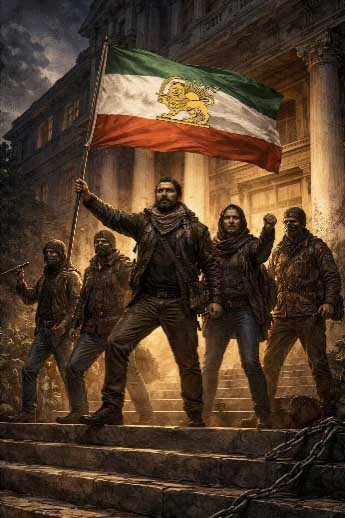
our brothers and sisters, our children and our friends carried out on the 8th and 9th of January in Iran, when they cried out the call for unity—which is the overthrow of the Islamic regime—and the single slogan of, “Long Live the Shah,” with their blood, and in their blood.
Yes, you are not required to perform loud or flashy acts beyond your capacity for show. But you must pay the price, and you must accept a lifelong covenant and commitment.
(Service is not limited to marching and chanting.)
Now that widespread poverty and suffocation have crushed both the lower classes and the middle class, civil society— The educated, freedom-seeking, culturally aware citizens engaged in urban life—has risen up and cries out:
“What about me?
Where is my share?
Where is my future, and the future of my children?”
Never in Iran’s history, relative to its population, has civil society—urban and rural—been so extensive. Driven by the advancing force of history, and shaped by exposure to the internet, satellite television, social and political networks, and by comparing itself with the modern world, our society has never been so aware of individual and social rights, nor so conscious of a modern understanding of quality of life— of how things ought to be, and how they are not.
The struggle between life and death, between the people and the regime, has now reached a stalemate— a revolutionary moment has emerged.
The regime, in the backgammon of survival, is trapped with no moves left, its dice soaked in blood. And we, my friends— As Ferdowsi said:
What do you see, all together, in this moment of action?
What move will you make in this blood-stained game?