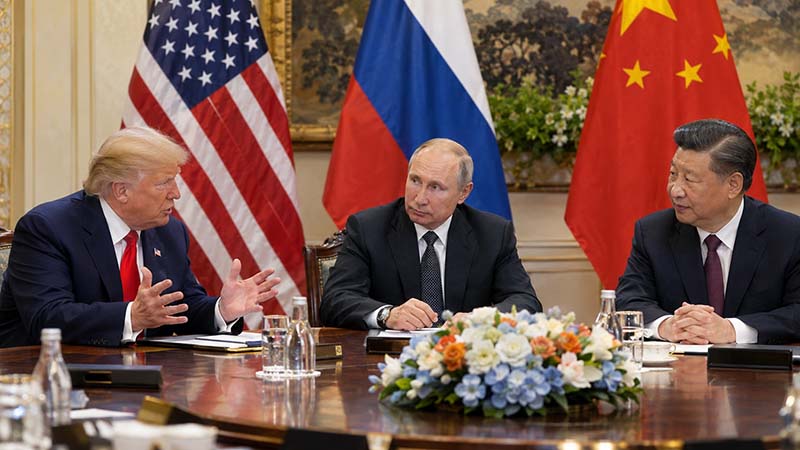


Payam Javan: President Donald Trump has participated in a historic trilateral summit alongside Russian President Vladimir Putin and Chinese leader Xi Jinping. This unprecedented meeting marks the first time the heads of the world’s three largest nuclear powers have gathered for a dedicated sit-down to address pressing geopolitical concerns. The event, held in the context of the President’s broader tour through Asia, signals a significant moment for international diplomacy and strategic engagement.
A primary focus of the U.S. agenda for this summit centers on the complex issue of global denuclearization. While Washington has long advocated for comprehensive discussions regarding the reduction of nuclear arsenals, both Beijing and Moscow have historically demonstrated varying levels of resistance to such trilateral frameworks. President Trump expressed a desire to address these challenges directly, emphasizing that meaningful arms control requires the participation of all three major powers.
During his opening remarks, President Trump highlighted the collective responsibility shared by the leaders to maintain productive dialogue. He stated that the three nations have much to discuss and underscored the importance of fostering respectful communication, even when significant disagreements exist. The President noted that avoiding dialogue with nations holding differing perspectives has been a failing of past leadership, and he advocated for a more engaged approach to global stability.
Regional conflicts, including the ongoing situations in Ukraine and Iran, were also identified as key components of the discussions. According to reports from the Kremlin, the conflict in Ukraine featured prominently in the exchange between President Trump and President Putin. Russian officials indicated that the dialogue was conducted in a constructive atmosphere, though specific details regarding potential agreements or diplomatic breakthroughs remained limited following the conclusion of the session.
Preparations for the summit involved significant anticipation regarding the possibility of a joint statement. Kremlin representatives had previously suggested that while the leaders might reach a consensus on certain issues, the nature of such high-level negotiations meant that outcomes were not guaranteed until the final moments of the meeting. This uncertainty underscores the delicate balance the three nations must navigate as they attempt to reconcile their competing strategic interests.
This gathering follows President Trump’s participation in a series of diplomatic events in the Philippines, including the inaugural meeting of the QUAD, which involves the United States, Japan, Australia, and India. The trilateral summit takes place against a backdrop of strengthening strategic ties between Beijing and Moscow, providing a complex environment for the United States to pursue its policy objectives. The administration continues to emphasize that a tripartite approach is essential for achieving true global arms control.
As the summit concludes, the international community remains focused on the potential long-term implications of this high-stakes meeting. By bringing the leaders of the United States, Russia, and China to the same table, the event has established a new precedent for how these major powers handle their mutual challenges. Future developments will reveal whether this dialogue can serve as a foundation for sustained cooperation on nuclear security and regional stability.