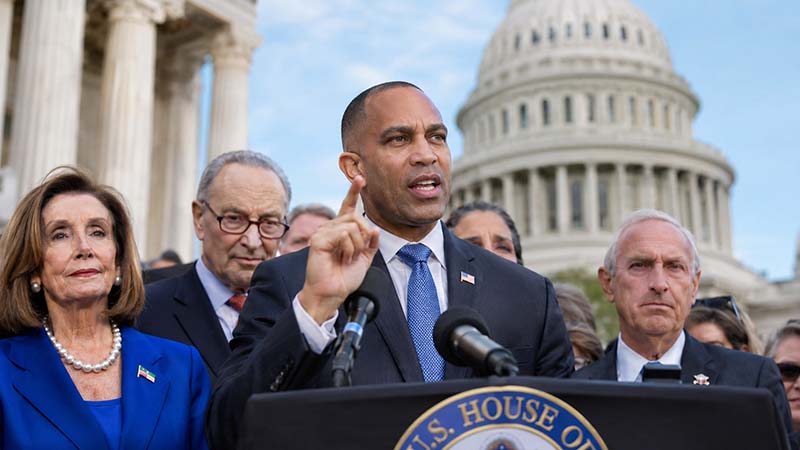


Payam Javan: The Democratic Party has secured a majority in the U.S. House of Representatives, effectively granting them control over both chambers of Congress. Projections from The Associated Press confirmed that Democrats surpassed the 218-seat threshold required to hold the House majority, building on their earlier success in reclaiming control of the Senate during the same election cycle. This shift marks a significant realignment of legislative power in Washington.
House Minority Leader Hakeem Jeffries celebrated the milestone, framing the victory as a mandate for change. He emphasized that the party intends to focus on delivering legislative results and addressing public concerns regarding government transparency immediately upon taking office in January. In response to the shift in congressional balance, President Donald Trump acknowledged the Democratic success. While expressing a willingness to cooperate with the new majority on specific policy areas, he signaled that he would maintain firm opposition on contentious issues, including border security and social policies.
This sets a complex landscape for future legislative negotiations. The Democratic path to the House majority was paved by notable gains in several battleground districts. Key victories included flips in North Carolina’s 11th Congressional District and New Jersey’s Seventh Congressional District, where Democratic candidates managed to unseat Republican incumbents or secure open seats. These results exceeded expectations in areas previously considered competitive or leaning toward the GOP.
Furthermore, Democratic candidates successfully defended seats in regions that had recently been redrawn to favor Republican interests, such as Florida’s 14th, 22nd, and 25th districts. The party also saw successful outcomes in Pennsylvania, Virginia, Kentucky, and Ohio, demonstrating a broad electoral reach that allowed them to withstand structural challenges and solidify their legislative standing.
In the Senate, the Democratic performance was equally robust, with victories in states traditionally considered Republican strongholds. Wins in South Carolina, Texas, and Kansas, alongside victories in battlegrounds like Georgia and North Carolina, have reshaped the upper chamber. These results suggest a significant shift in the national political mood, as incumbents and challengers alike navigated a highly polarized environment. The shift in congressional control grants Democrats significant oversight authority, including the power to issue subpoenas and initiate investigations into the executive branch.
While the party has expressed an intent to utilize these tools, internal discussions continue regarding the strategic approach to potential high-stakes actions, such as impeachment proceedings, which remain a subject of debate within the caucus. As Democrats prepare to govern, Minority Leader Hakeem Jeffries faces the challenge of managing a diverse caucus.
Balancing the priorities of moderate and progressive members will be essential for maintaining party unity as they pursue their legislative agenda. The size of the final majority remains a key factor in determining the party’s ability to navigate the upcoming sessions and address the nation’s pressing policy demands.