
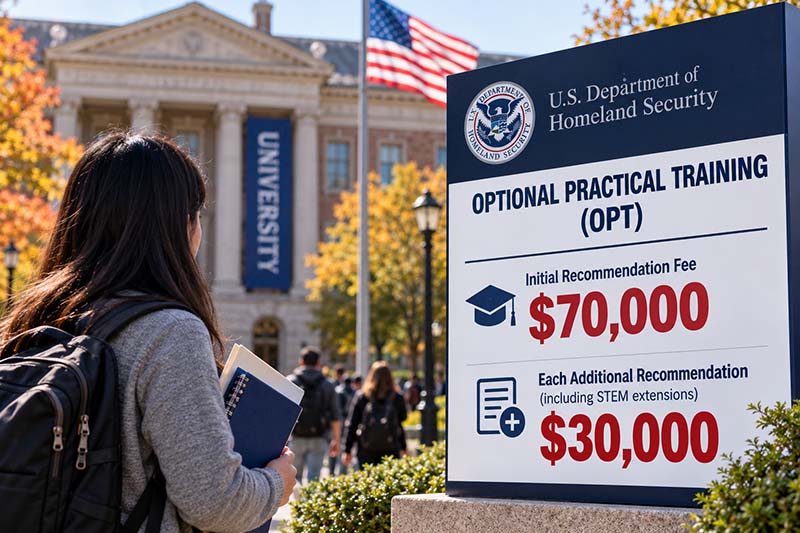


Payam Javan: The Department of Homeland Security has announced a controversial new proposal that would require colleges and universities to pay a substantial $70,000 fee before recommending an international student for a prominent United States work program. The regulatory measure targets the Optional Practical Training program, which currently allows eligible foreign graduates to gain temporary employment experience directly related to their major fields of study.
According to the policy announcement, educational institutions would also face an additional $30,000 charge for each subsequent recommendation, including the popular STEM extensions for graduates in science, technology, engineering, and mathematics disciplines. A departmental spokesperson defended the initiative by asserting that American workers should not be forced to compete with programs perceived as pipelines for inexpensive foreign labor.
The agency emphasized that the Optional Practical Training framework was never intended to serve as an alternate route into the domestic workforce, a wage subsidy for corporations, or an incentive for systemic exploitation. Officials stated that the overhaul is designed to compel foreign participants to clearly demonstrate their value to prospective employers while curbing potential abuses.
While the sweeping proposal has been officially introduced, the financial requirements are not yet implemented. The department has opened a designated window for public comments, inviting feedback from stakeholders and educational institutions before moving forward with any final regulatory determinations.
Although the preliminary financial obligation falls directly upon the academic institutions, the administration has acknowledged that the costs will likely be transferred to international students, the broader student population, or hiring employers. Officials noted that while these figures represent significant expenditures, the economic barrier is intended to discourage misuse of the employment system.
The department maintains that the financial deterrents will effectively discourage individuals whose primary objective is permanent residency or employment rather than legitimate academic pursuits. Furthermore, the initiative seeks to prevent companies from utilizing the program to bypass standard H-1B visa limitations, prevailing wage mandates, and associated administrative fees.
Implementation details specify that payment verification must occur prior to institutional recommendation and subsequent federal employment authorization. The United States Citizenship and Immigration Services would be instructed to withhold approval for work permits unless confirmation of the required treasury payment is formally established.
The policy proposal references a recent federal investigation that uncovered thousands of international students allegedly employed by highly questionable enterprises. Investigators reportedly discovered vacant properties, fabricated employment documentation, residential locations registered as commercial worksites, and a complete absence of legitimate employment records.
In sharp contrast to the administration’s stance, educational associations such as NAFSA have strongly criticized the measure, warning that restricting the program will ultimately undermine American technological innovation and international competitiveness. Advocates argue that deterring global talent will merely divert skilled professionals and economic benefits to competing nations abroad.


