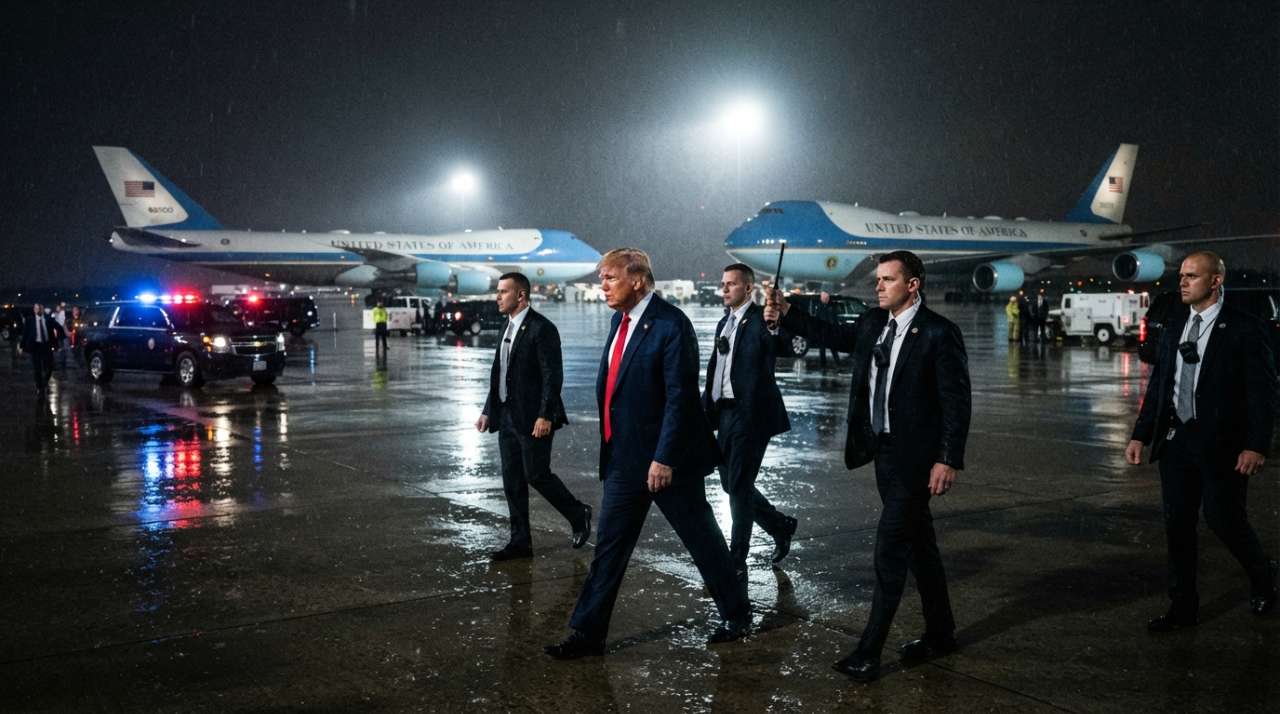


Payam Javan: U.S. President Donald Trump disclosed on August 11 that the Secret Service directed him to switch from the primary Air Force One aircraft to a military plane when departing Ankara, Turkey, last month. The decision, made on July 8 following the conclusion of a two-day NATO summit, was prompted by an undisclosed security threat. President Trump indicated that he complied with the instructions of the Secret Service and military personnel without seeking detailed information regarding the specific nature of the threat.
The president had initially arrived in Turkey on July 7 aboard a newly acquired Boeing 747-8 luxury jet, which was gifted to the U.S. federal government by Qatar last year. However, for his departure, security officials arranged for him to travel on an older Air Force One model. White House Communications Director Steven Cheung later clarified that the aircraft substitution was a deliberate measure of “distraction and misdirection” designed to mitigate potential risks to the president’s safety.
According to administration officials, the president faces ongoing security challenges from various international adversaries. Cheung emphasized that the U.S. government remains committed to utilizing all available resources and strategies to counter these threats. The incident highlights the heightened security protocols surrounding presidential travel during periods of elevated geopolitical tension.
The security alert coincided with a significant escalation in tensions between the United States and Iran. Speaking to reporters at the NATO summit, President Trump identified himself as a primary target for Iranian retaliation following the collapse of a bilateral ceasefire agreement. The preliminary accord, signed in June to halt hostilities and reopen the strategic Strait of Hormuz, fell apart after the U.S. accused Iran of attacking commercial vessels, prompting retaliatory U.S. airstrikes.
In response to the perceived threat of assassination, President Trump issued a stern warning via social media, stating that he had authorized the U.S. military to take decisive action in the event of an attack on his life. He claimed that numerous missiles were prepared for immediate deployment against the Islamic Republic of Iran. The directive reportedly grants the military authorization to target Iranian infrastructure over a one-year period, subject to extension.
The friction between Washington and Tehran has intensified significantly since the death of Iran’s Supreme Leader, Ayatollah Ali Khamenei, who was killed in a joint U.S.-Israeli airstrike on February 28 aimed at disrupting Iran’s nuclear program. The assassination triggered a months-long military confrontation, disrupting global shipping lanes in the Strait of Hormuz as Iranian forces launched retaliatory operations against regional targets hosting U.S. military assets.
Following the burial of the late Supreme Leader on July 10, the Iranian Assembly of Experts appointed his son, Mojtaba Khamenei, as his successor. The newly designated leader has vowed to avenge his father’s death, further complicating diplomatic efforts and raising concerns over prolonged instability in the Middle East.