
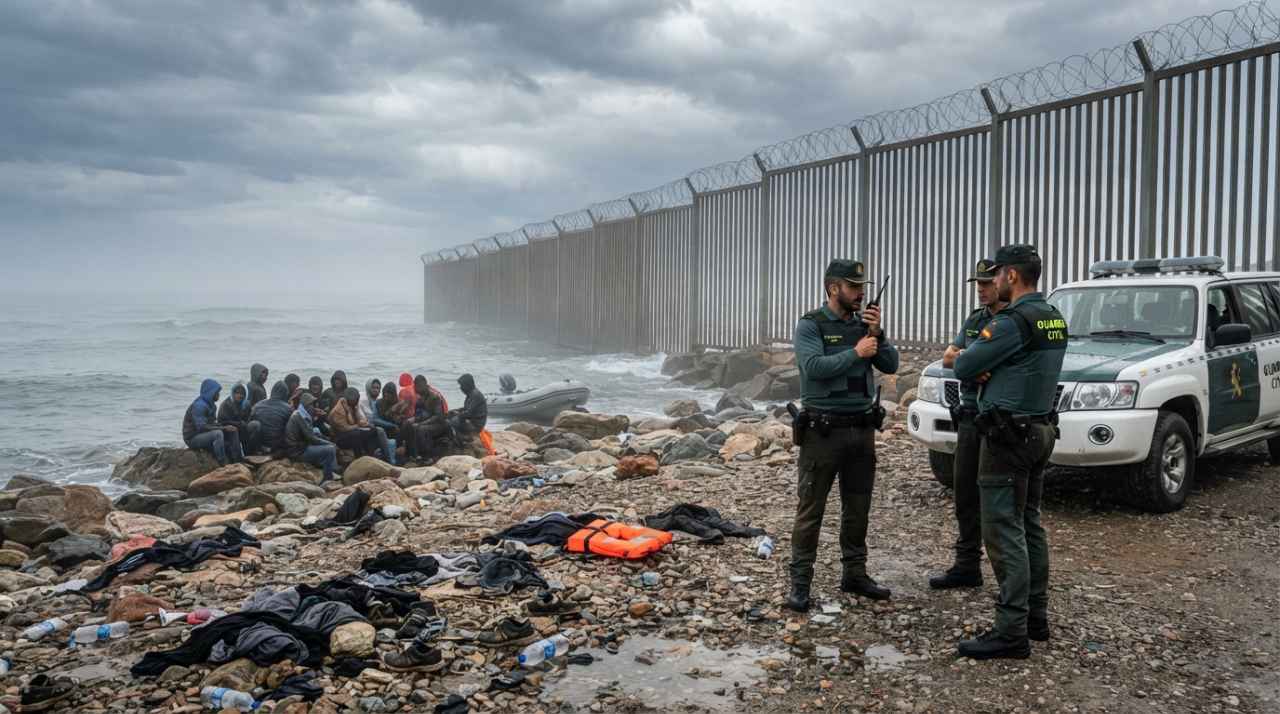


Payam Javan: The United States Embassy in Spain has issued a security alert following a major migration event in which thousands of migrants crossed from Morocco into the Spanish autonomous enclaves of Ceuta and Melilla. In response to the sudden influx, the Spanish government deployed military units to the border areas alongside the National Police and the Guardia Civil to assist in containing the situation. The deployment highlights the scale of the border pressure faced by the North African territories.
In its security alert, the U.S. Embassy cautioned that the arrival of thousands of migrants within a short period could lead to unpredictable and potentially dangerous situations. American citizens currently in or traveling to Spain were advised to avoid the affected regions, steer clear of demonstrations that might turn violent, and closely monitor local news updates. The State Department continues to recommend that travelers exercise increased caution in Spain under its standing Level 2 advisory.
Local authorities reported significant casualties associated with the border crossings, with at least 57 bodies recovered on the Spanish side of the border. Officials noted that some individuals drowned while attempting to swim around breakwaters, while others were crushed in the crowd near the border fences. Spain’s Interior Ministry estimated that approximately 50,000 people crossed the border starting Thursday morning, though the vast majority were reported to have returned shortly thereafter.
The sudden surge has prompted immediate policy shifts within the European Union, notably from Italy, which announced a temporary suspension of the Schengen border-free travel arrangements for passengers traveling between Italy and Spain by air or sea. Italian officials characterized the measure as a necessary step to safeguard national security and prevent uncontrolled migration flows. The Spanish government, however, criticized the decision, asserting that the suspension violates established European Union treaties.
The border crisis has also attracted international political attention, drawing comments from U.S. President Donald Trump, who compared the mass crossing to an invasion. During a Cabinet meeting, he utilized the situation in Spain to emphasize his stance on domestic border security, warning of similar challenges along the U.S. southern border. The remarks underscore how European migration developments continue to influence political debates across the Atlantic.
As security forces work to stabilize the border enclaves, the incident underscores the complex humanitarian and geopolitical dynamics of the Mediterranean migration route. Spanish and Moroccan authorities remain under pressure to manage the border effectively while addressing the safety of those attempting the crossing. The long-term impact on regional cooperation and European Union migration policy remains a subject of active debate among member states.


