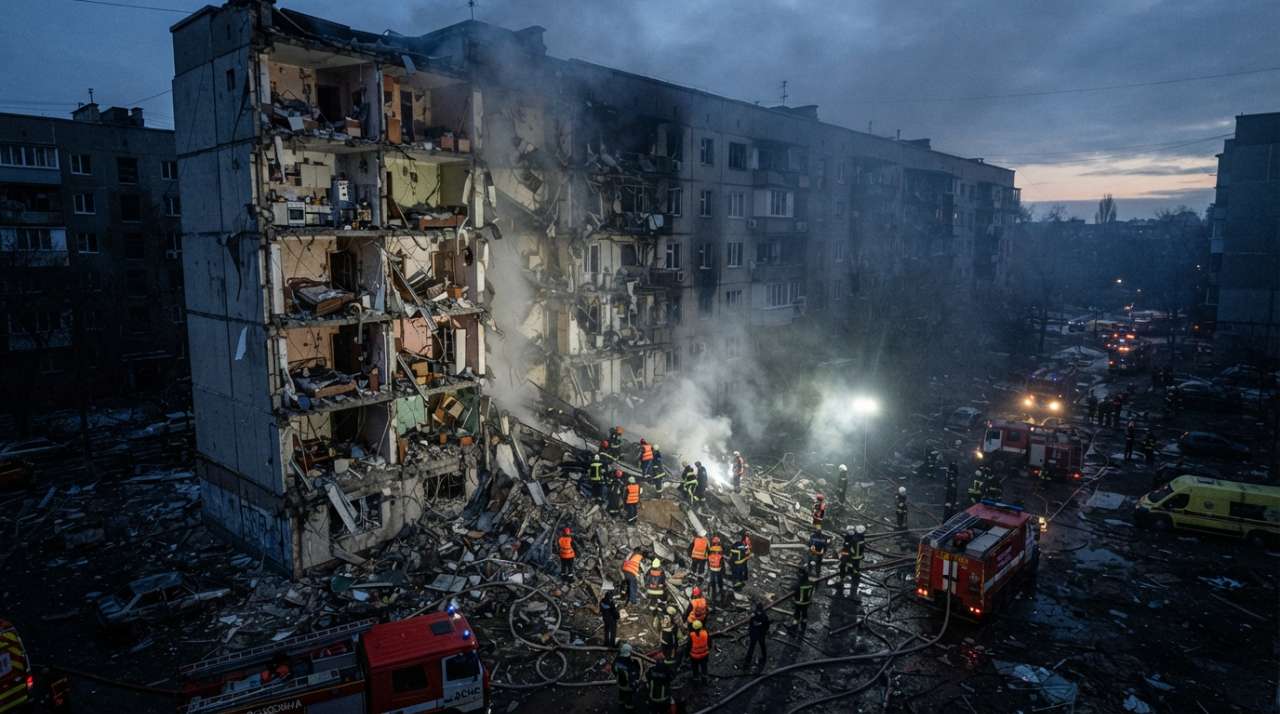


Russia launched a large-scale aerial assault on Kyiv, deploying hundreds of drones and dozens of missiles in the early hours of Thursday. The strikes resulted in at least 18 deaths and left dozens wounded, causing some of the most extensive damage to the Ukrainian capital this year. Multiple residential buildings were severely damaged, forcing thousands of residents to seek shelter in underground metro stations and bunkers as explosions reverberated across the city.
Ukrainian President Volodymyr Zelenskyy cut short an official visit to Ireland to return to Kyiv, where damage was reported across more than 20 sites. According to the Ukrainian Air Force, Russia launched 74 missiles and nearly 500 drones, with officials noting an unusually high number of ballistic missiles that proved difficult to intercept due to shortages of Patriot air defense systems. Zelenskyy renewed calls to international allies to prioritize air defense supplies and maintain support for purchasing advanced weaponry.
The Russian Defense Ministry characterized the operation as a “massive attack” using high-precision, long-range weapons targeting military, energy, and aviation infrastructure in Kyiv and other regions. Moscow stated the strikes were in retaliation for recent Ukrainian drone attacks on Russian domestic fuel supplies, including a strike on an oil refinery in the Nizhny Novgorod region. The Kremlin confirmed that President Vladimir Putin was briefed on the operations and stated that military pressure on Ukraine would continue to achieve its strategic objectives.
In response to the escalation, Kyiv Mayor Vitali Klitschko declared a day of mourning, while emergency services continued search and rescue operations amid heavily damaged civilian and scientific infrastructure, including the National Institute of Biochemistry. Internationally, European Union Ambassador Katarina Mathernova reported damage to diplomatic personnel accommodation, though no diplomats were injured. Neighboring Poland briefly scrambled fighter jets as a precautionary measure, reflecting heightened regional security concerns as the conflict continues to impact civilian areas.