

I am one who would not cast
This precious pearl of the Persian tongue
At the feet of swine.
By: Shardad Khabir
The book Animal Farm by George Orwell is a stark and gaunt portrayal of a dystopia — the supposed “ ideal society ”— serving as a full mirror and a prophetic vision of many revolutions. Although this work is, in essence, a satire of the Bolshevik Revolution in Russia, a glance at history and political events reveals that the author has also narrated the consequences of many other popular revolutions: in the form of a sharp and symbolic fable. Undoubtedly, works such as Aesop’s Fables and perhaps Kalila and Dimna — at least in their Indian tradition — may have served as models and inspirations for Orwell in choosing the symbolic style of Animal Farm .
Overall, the work demonstrates how the initial ideals of “ freedom and equality ” can transform into their very opposites : “ corruption and tyranny .”
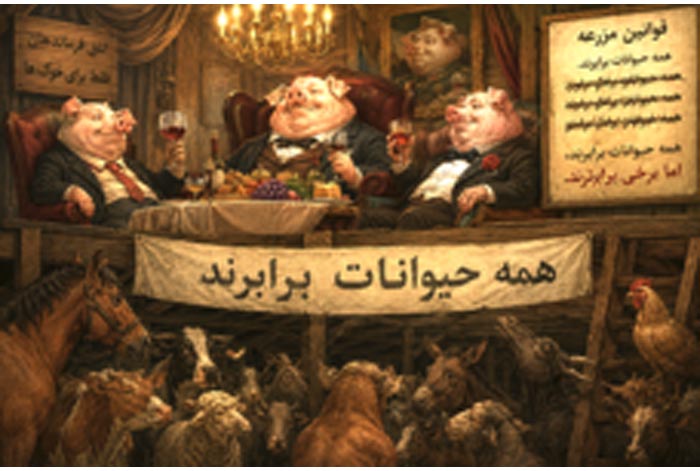
Animal Farm, with its simple yet symbolic prose, offers a profound critique of the lust for power and the corruptibility of human nature. It enables readers to reflect on politics and societal conditions and to consciously avoid being deceived by fake news and the propaganda of governments or their paid agents. The story is an allegory of events on a farm, beginning with the animals ’ uprising against their human owner, Mr. Jones. Under the leadership of the pigs — especially Napoleon and Snowball — they decide to take control of the farm and build an equal and just society. After their successful rebellion, the animals establish new laws, one of which declares : “ All animals are equal .”
Gradually, however, the pigs — who consider themselves the new leaders — begin to abuse their power. Napoleon, through terror and deception, eliminates his opponents, particularly Snowball. Over time, the original laws are altered, and Napoleon along with the other pigs adopts a life of luxury and excess. Ultimately, the slogan “ All animals are equal ” changes into : “ All animals are equal, but some animals are more greater than others .” The book illustrates how even the purest and most humane slogans about freedom and equality can be distorted into corruption, oppression, and privilege .
“ Mehr Licht! Macht doch die Fensterladen auf, damit ich mehr Licht bekomme !”
(“ More light! Open the window shutters so that more light may reach me !” — Johann Wolfgang von Goethe on his deathbed .)
Light — just a little more !
I wish to address the possibility of extending human lifespan — particularly that of ruling tyrants — and the direct consequence of prolonging their time in power .
One scientist at Russia ’ s National Medical Research Center described the directive to develop anti-aging and rejuvenation treatments for the ruling oligarchy as “ hypocrisy ”:
“ While hundreds of thousands of strong young Russians are being sent to a fratricidal war in Ukraine — to be torn apart in horrific deaths, or to return wounded and disabled in the prime of their youth — it seems that in this chaos, amid the relentless machinery of war and the slaughter of Russian youth, there is no one else worth saving, healing, or keeping alive except these empty-headed, self-satisfied warmongers .”
This situation brings to mind the metaphor of the “ merry sheikh, wine, and youth .” Dictators may take comfort in the idea of organ transplantation or even repeated rejuvenation, yet in reality, individuals who receive transplanted organs must, for medical reasons, take powerful anti-rejection drugs for the rest of their lives. These drugs suppress the immune system and can cause devastating side effects such as high blood pressure and increased risk of infection. Rejection occurs when the body ’ s immune system recognizes the transplanted organ as foreign and attacks it — even despite continuous medication to suppress that response .
Researchers are now using genetically modified pig genes to grow organs that are less likely to be rejected. Among mammals, humans possess the longest lifespan, yet they pay the price through disease, physical and mental decline, and dependence on treatments that are often both healing and harmful in old age. The risk of rejection is minimized when donor and recipient share genetic similarity — as has long been the case with organ, bone marrow, or blood donations, preferably from relatives .
The genetic compatibility and transplantation of pig organs into these “ pig-like ” rulers becomes, in itself, a bitter irony of human evolution and society — a grim, almost divine inevitability that sustains injustice against humanity, rather than, like Goethe on his deathbed, calling for more light — more awareness and justice — for humankind .
Finally, I turn to the continuation of the story of Genghis Khan and his request for the elixir of youth from the aged Chinese sage Chang Chun — whose second part I had not the opportunity to write due to the rapid events of recent months :
Sometime later, the Mongol army began its return journey northward toward Samarkand through Transoxiana. Along the way, Genghis Khan repeatedly sent the sage gifts of grape wine, melons, and various delicacies. During one encampment, he summoned Chang Chun, saying he awaited him for an important discussion. When the noise of the camp subsided and the croaking of frogs echoed through the air, the wise old man was led to the late Genghis Khan .
Inside the grand tent, tall candelabras with thick candles illuminated the space. Genghis Khan sat cross-legged upon a raised platform, leaning against a white cushion. The wide brim of his polished leather cap, from which several black tassels hung, cast a shadow over his face, leaving only his eyes — gleaming like those of a leopard — visible. Two scribes, fluent in both Chinese and Mongolian, sat by the throne upon a carpet. Chang Chun sat facing the Khan and said :
“ I am a wild hermit of the mountains, and for many years I have practiced the Tao — the path of the highest and most sublime essence …”
To be continued